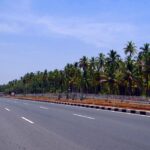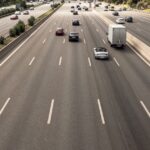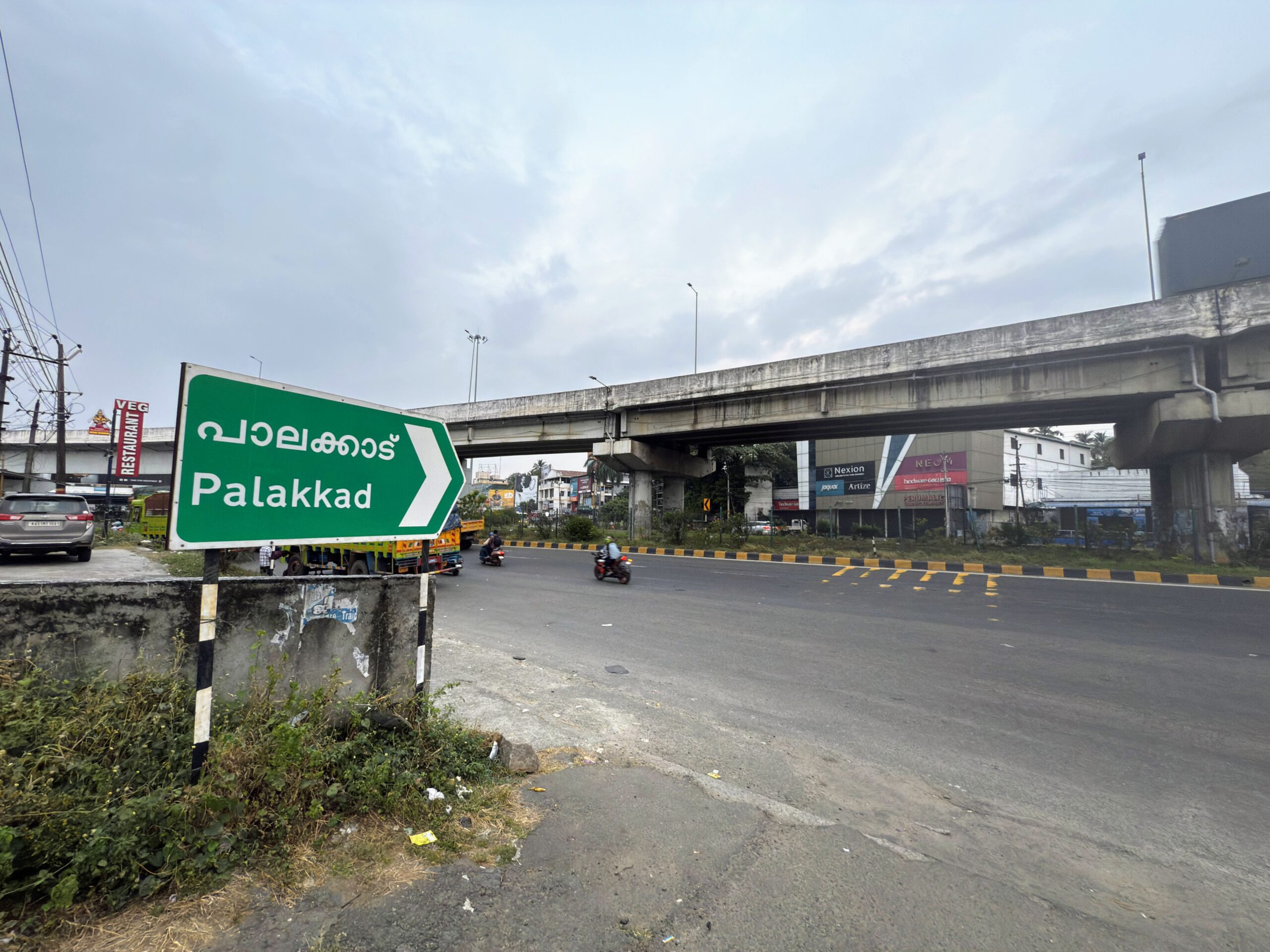
Every NRI who lands in Kochi or Delhi after years abroad says the same thing. “Roads have improved so much!” And every foreign tourist who takes a taxi from the airport says the opposite. “How do people drive here?”
Both are right. That is the confusing part.
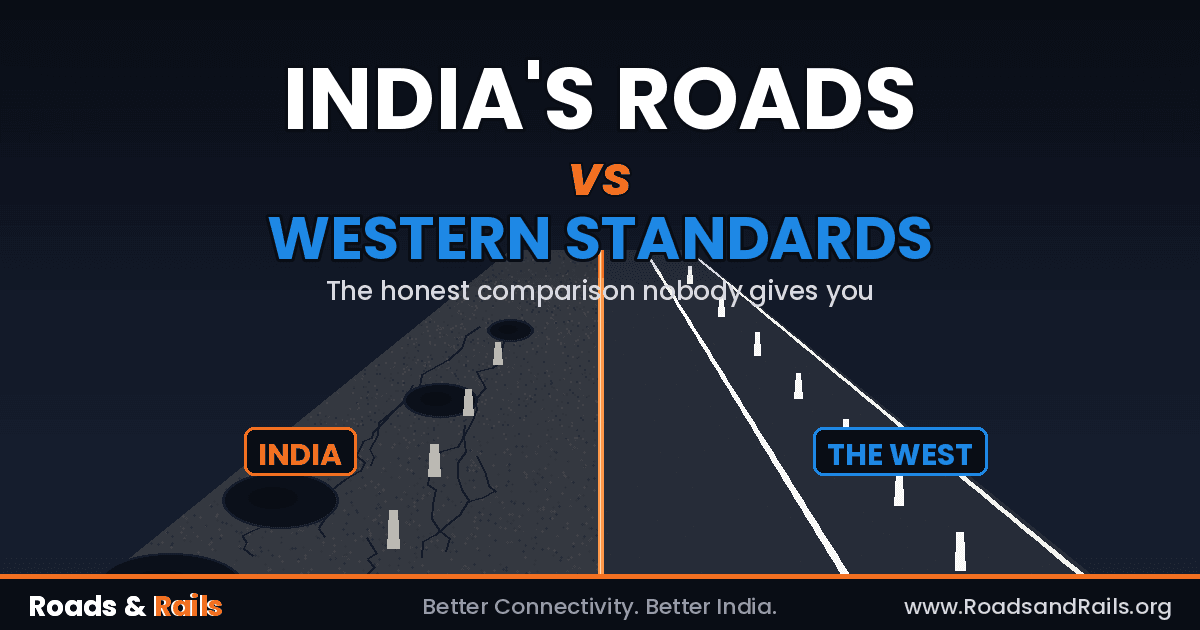
This post is an honest, no-drama comparison of Indian roads against Western standards, mainly the US and Europe. Not to shame India, not to blindly defend it either. Just facts, context, and what actually matters when you compare a country building highways at record speed with countries that finished their networks 60 years ago.
First, the numbers: India is not small anymore
India today has one of the largest road networks in the world, over 63 lakh km (approx. 6.3 million km) of total road length. That puts us second only to the USA in sheer network size. National Highways alone have crossed 1.4 lakh km (approx), nearly doubling in the last decade.
Construction pace is the real story. India has been building national highways at roughly 28 to 34 km per day in recent years (approx figures, please verify latest MoRTH data as these change every financial year). No Western country is building at this pace today, simply because they do not need to. The US Interstate system was largely completed by the 1980s. Germany’s autobahn network matured decades ago.
So when someone says “Western roads are better”, the fair reply is: they should be. They finished building. We are still mid-construction, on a much larger population base, with far less money per capita.
That context matters. But it does not excuse everything. Now the uncomfortable part.
Where Western standards genuinely beat us
1. Consistency. This is the single biggest gap. A German autobahn is the same quality in Bavaria and in Brandenburg. In India, you can drive on a world-class access-controlled expressway like the Mumbai-Nagpur Samruddhi Mahamarg, then take one exit and land on a state road with craters. Our best roads match anything in the West. Our average road does not. Western standards are about the average, not the showcase.
2. Road safety. No sugar-coating here. India records around 1.7 lakh road deaths a year (approx, per MoRTH annual reports, verify latest). That is among the highest in the world in absolute numbers. Per vehicle-km, we are far behind Western Europe, where countries like Sweden and Norway have pushed fatalities down through the “Vision Zero” approach: forgiving road design, strict enforcement, crash barriers, proper lighting. In India, a divider often just ends. A highway passes straight through a village market with no service road. Pedestrians and two-wheelers share space with 40-tonne trucks. Engineering can fix much of this and slowly it is happening, but the gap is real and it costs lives daily.
3. Enforcement and driving culture. Western roads work partly because rules are enforced boringly and predictably. Lane discipline, speed cameras, drink-driving checks. In India, enforcement is patchy. A brilliant 8-lane expressway with tractors going the wrong way is not an engineering failure, it is a governance failure. Concrete cannot solve that.
4. Maintenance. The West budgets for maintenance as seriously as construction. In India, ribbon-cutting gets headlines, resurfacing does not. One monsoon can undo a road that took two years to build, partly climate, partly poor drainage design, partly contractor shortcuts. Kerala folks know this cycle by heart: road relaid in March, potholes by August.
Where India is actually ahead or catching up fast
This part surprises Western readers.
Tolling technology. FASTag made electronic toll collection near-universal in India within a couple of years. Many US states still have cash lanes and incompatible toll systems between states. India leapfrogged, and GPS-based tolling trials are already underway.
Greenfield expressway design. New Indian expressways like the Delhi-Mumbai Expressway are being built to modern specs from day one: access control, wayside amenities, provisions for EV charging, some stretches even designed for emergency aircraft landing. When you build late, you build with the latest playbook. The West is stuck retrofitting old infrastructure.
Scale of rural connectivity. The PMGSY rural roads programme connected lakhs of habitations that had no all-weather road at all. There is no Western equivalent of this challenge in living memory. Connecting a remote village for the first time changes lives more than widening an already-good suburban road. Different game entirely.
Cost efficiency. India builds highways at a fraction of Western per-km costs. Yes, some of that is lower labour cost and sometimes thinner specs, but a lot is genuine efficiency born of doing it at massive scale, continuously.
The comparison most people get wrong
Comparing India’s roads to Western standards as a single scoreboard is lazy. The honest framing is three separate questions:
- Can India build to Western standards? Yes, proven. Atal Tunnel, Chenab bridge approaches, the new expressways. The engineering capability exists.
- Does the average Indian road meet Western standards? No, and it will take a decade or more of maintenance discipline, drainage investment, and enforcement to close that gap.
- Is India improving faster than the West? Clearly yes, because the West is largely done and we are mid-sprint.
Western standards are the destination. India’s real challenge is not laying tarmac, we have become genuinely good at that. The challenge is everything around the tarmac: safety engineering, enforcement, maintenance culture, and making sure the ordinary district road gets the same respect as the flagship expressway.
One clear takeaway
Judge India’s roads not by the best expressway or the worst pothole, but by the trendline. The trendline is steeply upward on construction and connectivity, and painfully slow on safety and maintenance. Fix those two, and the “vs Western standards” debate ends itself within a generation.
Better connectivity, better India. But connectivity without safety is only half the promise.
Note: Figures marked approx are based on Ministry of Road Transport and Highways (MoRTH) data and public reports. Numbers change yearly, verify from morth.nic.in for the latest.