Kerala has been discussing “high-speed rail” for more than a decade. From SilverLine to bullet train dreams, many proposals have come and gone. But the real question remains:
What kind of high-speed rail actually works for Kerala’s geography, population, and economy?
The honest answer is simple: Kerala does not need a 350 kmph bullet train. Kerala needs a fast, frequent, affordable, and integrated rail system.
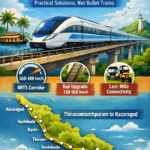
And today, the best-fit solution is a Statewide RRTS-style corridor (160–180 kmph) combined with upgrades to existing railway lines.
Kerala’s Unique Transport Challenge
- Narrow and linear (north to south)
- Densely populated almost everywhere
- Full of rivers, backwaters, wetlands, and hills
- Highly sensitive to land acquisition issues
- Environmentally fragile
Any rail project that ignores this reality will fail socially, legally, and financially.
Why Bullet Trains Don’t Suit Kerala
Many people dream of Japanese-style bullet trains. But in Kerala, they are mostly impractical.
- Land Requirement – Needs long, straight corridors
- High Cost – ₹250 to ₹300 crore per km
- Limited Stops – Excludes smaller towns
- Social Resistance – Protests and court cases
Result: Big announcements, little delivery.
The RRTS Model: Kerala’s Best Option
The Regional Rapid Transit System (RRTS) is designed for dense regions like Kerala.
- Top speed: 160 to 180 kmph
- Average speed: 90 to 100 kmph
- Mostly elevated tracks
- Stations every 20 to 25 km
- High frequency services
- Metro-like comfort
It sits between metro and bullet train and is ideal for Kerala.
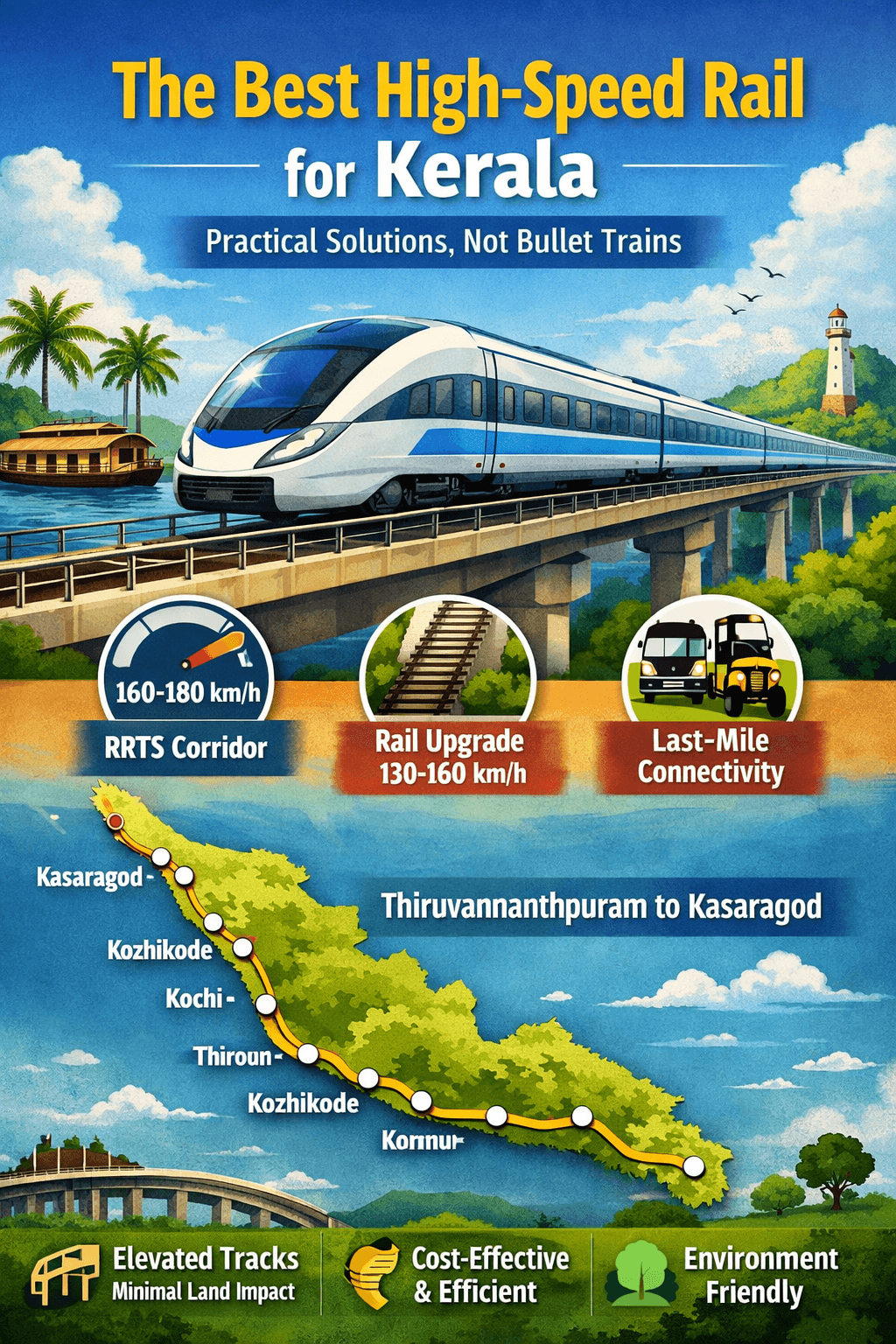
Proposed Thiruvananthapuram to Kasaragod Corridor
The proposed corridor covers about 580 km and connects major urban centres:
- Thiruvananthapuram
- Kollam
- Alappuzha
- Kochi
- Thrissur
- Kozhikode
- Kannur
- Kasaragod
Expected travel time: 4 to 5 hours end-to-end.
Why Elevated Tracks Make Sense
- Lower land acquisition
- Fewer demolitions
- Reduced flooding impact
- Faster construction
- Lower legal hurdles
This approach fits Kerala’s terrain better than ground-level corridors.
Upgrading Existing Rail Lines
RRTS must be supported by modernised Indian Railways tracks.
- Track strengthening
- Advanced signalling systems
- Fencing and safety barriers
- Level crossing elimination
- Improved electrification
- Curve realignment
These upgrades enable 130 to 160 kmph operations.
Last-Mile Connectivity: The Success Factor
Fast trains mean nothing without easy station access.
- KSRTC and city buses
- Kochi Metro and future metros
- Auto and taxi zones
- Parking facilities
- Footpaths and cycling tracks
Without strong last-mile planning, ridership will suffer.
Cost vs Benefit Comparison
| System | Speed | Cost | Suitability |
|---|---|---|---|
| Bullet Train | 300+ kmph | Very High | Low |
| RRTS | 160 kmph | Medium | High |
| Railway Upgrade | 130–160 kmph | Low | High |
Environmental Responsibility
- Lower carbon emissions
- Reduced road congestion
- Less fuel consumption
- Smaller land footprint
- Minimal ecological disruption
Every passenger shifted from road to rail supports climate goals.
What Kerala Really Needs
- Reliable schedules
- Affordable fares
- Clean stations
- Safe travel
- Integrated transport
- Shorter commute times
Speed matters only when supported by quality infrastructure.
Final Recommendation
- Statewide RRTS corridor (160 to 180 kmph)
- Upgraded existing rail lines
- Strong last-mile connectivity
- Environmental safeguards
This approach balances speed, cost, and sustainability. It focuses on real public benefit, not political headlines.