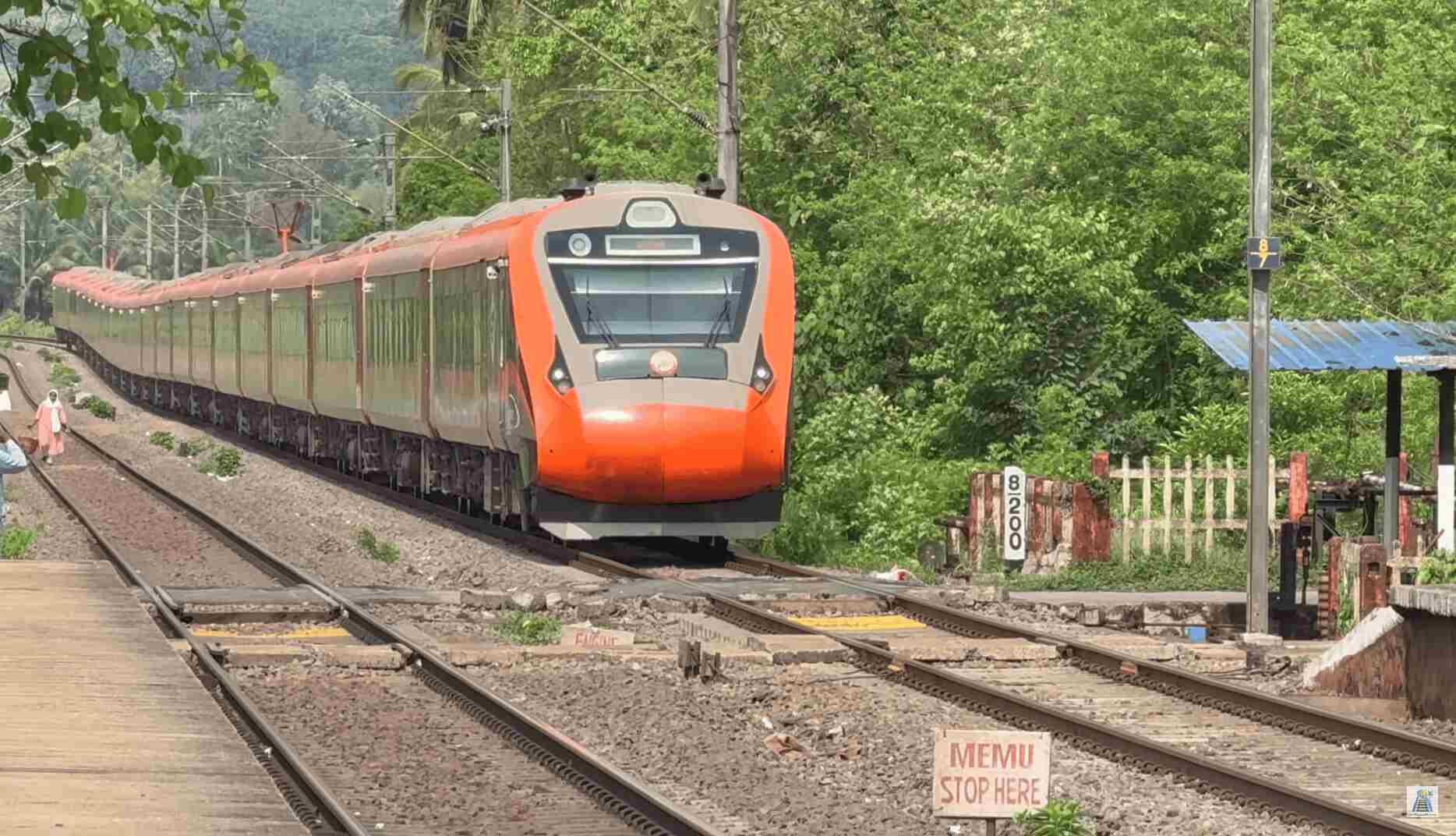
Bengaluru Ernakulam Vande Bharat Express
Distance: 625 km • Scheduled Time: 8 h 40 m • Average Speed: ~72 km/h
Route: KSR Bengaluru City Junction (SBC) → Ernakulam Junction (ERS)
Launch expected: 7 November 2025 (tentative) The Times of India+1
Train Numbers: 26651 (SBC→ERS) and 26652 (ERS→SBC)
Yesterday Indian Railways has announced a new Vande Bharat service between Bengaluru and Ernakulam, promising faster travel, premium amenities and better connectivity. But a closer look reveals a gap between the promise and the performance — and in that gap resides the infrastructure challenge: a sleek, high-performance trainset riding on tracks that aren’t built for full speed.
Route, Timings & Halts (Complete)
Below are the detailed schedules for both directions, incorporating the intermediate arrivals/departures you provided:
26651: SBC → ERS
| # | Station Code | Station Name | Arrives | Departs | Halt (min) | Section Time* |
|---|---|---|---|---|---|---|
| 1 | SBC | KSR Bengaluru City Jn | – | 05:10 | – | – |
| 2 | KJM | Krishnarajapuram | 05:23 | 05:25 | 2 | 0:13 |
| 3 | SA | Salem Jn | 08:13 | 08:15 | 2 | 2:48 |
| 4 | ED | Erode Jn | 09:00 | 09:05 | 5 | 0:45 |
| 5 | TUP | Tiruppur | 09:45 | 09:47 | 2 | 0:46 |
| 6 | CBE | Coimbatore Jn | 10:33 | 10:35 | 2 | 0:46 |
| 7 | PGT | Palakkad Jn | 11:28 | 11:30 | 2 | 0:53 |
| 8 | TCR | Thrissur | 12:28 | 12:30 | 2 | 0:58 |
| 9 | ERS | Ernakulam Jn | 13:50 | – | – | 1:20 |
*Section time = time between previous departure and arrival at this station.
26652: ERS → SBC
| # | Station Code | Station Name | Arrives | Departs | Halt (min) | Section Time* |
|---|---|---|---|---|---|---|
| 1 | ERS | Ernakulam Jn | – | 14:20 | – | – |
| 2 | TCR | Thrissur | 15:17 | 15:20 | 3 | 0:57 |
| 3 | PGT | Palakkad Jn | 16:35 | 16:37 | 2 | 1:15 |
| 4 | CBE | Coimbatore Jn | 17:20 | 17:22 | 2 | 0:43 |
| 5 | TUP | Tiruppur | 18:03 | 18:05 | 2 | 0:40 |
| 6 | ED | Erode Jn | 18:45 | 18:50 | 5 | 0:40 |
| 7 | SA | Salem Jn | 19:18 | 19:20 | 2 | 0:28 |
| 8 | KJM | Krishnarajapuram | 22:23 | 22:25 | 2 | 3:03 |
| 9 | SBC | KSR Bengaluru City Jn | 23:00 | – | – | 0:35 |
These timings show both the promise (a “premium” train between major metros) and the constraints (long sections of > 45-60 minutes between stops, mixed traffic, dwell times).
Why The Average Speed (72 km/h) Is So Low
On paper, the Vande Bharat trainset can do up to 160 km/h for commercial service, and is designed for up to ~180 km/h in trials. The Indian Express+2Wikipedia+2
Yet this corridor — despite the modern train — clocks an average of only ~72 km/h. That’s comparable not to modern “high-speed” corridors in other countries, but to older express services in India.
Here are the key reasons:
Track limitations: Only about one-fifth of the Indian Railways network is rated for 130 km/h speeds. Around 23,000 track km out of ~103,000 km support 130 km/h; most of the rest are rated for lower speeds (110 km/h or less). The Times of India
Mixed traffic corridors: This route carries freight, suburban, express traffic. Freight trains slow down the corridor pace.
Frequent halts & alignment: The schedule includes 9 official halts, but between them lie dozens of “intermediate stations” (109 intermediate stations noted for this route) — a route hardly optimized for high-speed.
Signalling & safety systems: Modern high-speed corridors use advanced signalling (ETCS, automated train protection). Many conventional Indian Railway sectors still use legacy systems, forcing speed restrictions. thecore.in+1
Geography and route alignment: The Bengaluru–Ernakulam corridor passes through the Western Ghats region (Palakkad Gap, Thrissur, Coimbatore etc), with curvature, gradients and terrain that impose structural speed limits.
Average speed drop nationwide: Data show the average speed of Vande Bharat trains nationwide has fallen from ~84.48 km/h in 2020-21 to ~76.25 km/h in 2023-24. The Indian Express+1
In short: The train is capable of much more, but is held back by the rails beneath it.
Benchmarking: What Other Countries Do
It’s instructive to look at how this 625 km journey stacks up internationally.
In Japan, the famed Shinkansen covers ~515 km between Tokyo and Osaka in ~2 h 30 m — average ~200 km/h.
In China, the Beijing–Shanghai corridor (~1,318 km) is covered in ~4.5 hours — average ~290 km/h.
In Europe, high-speed trains (TGV in France, ICE in Germany) routinely average 200-320 km/h on dedicated tracks.
In the U.S., Amtrak’s Acela Express averages ~113 km/h on the Boston–Washington D.C. corridor (~735 km).
Contrast that with Bengaluru–Ernakulam: 625 km in 8 h 40 m → ~72 km/h. A distance many countries cover in 3-4 hours is taking nearly twice that time here. The rolling stock (trainset) is not the bottleneck — the network is.
Why This Matters (Beyond the Travel Time)
It’s easy to see this as a headline: “premium train takes 8h40m”. But the implications are deeper.
Connectivity and regional development
The corridor links Bengaluru (technology hub) with Kochi/Ernakulam (major port + commercial centre) via Coimbatore, Palakkad, Thrissur, Erode, Salem. Faster rail links could drive regional economies, ease commuter flows, support tourism and logistics. A true 4-5 hour link would change commuting patterns; at 8+ hours it remains an overnight or “travel-day” journey.
Sustainability
Trains have far lower emissions per passenger-km than cars or planes. But if the train journey is slow, people often opt for flights or road travel. Modern, fast rail shifts mode share. Without faster average speeds, the advantage is muted.
Economic costs
Time is money. An 8+ hour journey means passengers spend more idle time, freight moves slower, logistics chains stay inefficient. The opportunity cost is real — productivity losses, delay costs, and a competitive disadvantage for the region.
Infrastructure & safety
Pushing trains to higher speeds without matching infrastructure is a safety risk. Legacy tracks, weaker geometry, shared traffic and outdated signalling all pose hazards. The decline in average speeds reflects a cautious approach by the railways. mint+1
Where the New Vande Bharat Service Stands
Pros:
Modern trainset: the Vande Bharat design features faster acceleration, better passenger comfort, bio-vacuum toilets, onboard infotainment and WiFi (in many sets).
Premium positioning: fewer stops, higher priority, comfort advantage.
Good for the corridor: The announcement of this service reinforces demand between Bengaluru and Kerala. The Times of India+1
Cons (and contradictions):
The average speed (72 km/h) undermines the “semi-high-speed” tag.
With 9 halts + 100-odd intermediate stations, the route isn’t optimised for high speed — more like a fast express than a corridor train.
Infrastructure readiness is limited: the tracks, signals and alignment are not yet high-speed ready.
Unique aspects of the corridor:
It is 625 km via this route. Some sources mention ~608 km for earlier specials, but the approved route shows 625 km.
The rail corridor passes through multiple states and rail divisions (Karnataka → Tamil Nadu → Kerala), increasing operational complexity.
It passes through challenging terrain (Ghats, gradients) in the Palakkad–Thrissur region.
What Needs to Change for Real High-Speed Performance
Here’s a roadmap for upgrading so that future Vande Bharats (or bullet trains) don’t just look fast, but perform fast:
Track upgrades
Realign curves, reduce gradients, use continuous welded rails, upgrade ballast.
Raise corridor certification to 130-160 km/h (or more) for long stretches. For context: only ~23,000 km of Indian tracks currently support 130 km/h. The Times of India
Segregated corridors / freight diversion
Freight and passenger share lines now. To raise average speeds, dedicated fast-passenger corridors (or time windows) help.
Freight must be shifted to dedicated freight corridors (DFCs) so express services aren’t delayed or constrained.
Advanced signalling & automation
Legacy signalling constrains speed and headways. Adoption of ETCS-Level 2, automatic train protection, and real-time monitoring is essential. thecore.in+1
Improved access control: fencing, grade-separation of crossings, fewer interruptions.
Operational discipline & scheduling
Minimise dwell times, optimise halts, manage overtakes. In this corridor, some sections span >1h between halts — which kills average speed.
Stop spacing must reflect “corridor” trains vs local services.
Maintenance & network health
High-speed performance demands tighter tolerances in track geometry and alignment. Predictive maintenance regimes need to be adopted.
Investment in track-maintenance infrastructure pays off long-term.
Policy & investment alignment
Train sets like Vande Bharat are only as good as the corridor they run on. Infrastructure investment must go hand-in-hand with rolling stock procurement.
Transparent reporting of average speeds, punctuality and system bottlenecks will build accountability.
In short: A shining train on a slow track = still slow travel.
Final Thoughts: A Step Forward, But Not Yet a Leap
The Bengaluru–Ernakulam Vande Bharat Express is a welcome addition to the network — for what it represents: modern rolling stock, improved comfort, premium branding and a nod toward improved connectivity. But calling it a “high-speed” service is aspirational. At ~72 km/h average, it remains stuck in conventional express territory.
India is making strides — the trials of Vande Bharat Sleeper hitting 180 km/h have shown what’s possible. The Times of India+1 But ambition alone doesn’t change travel time. The rails, the signals, the corridors must be ready.
For the commuters, tourists, freight users and regional economies of the South-West corridor: yes, there is improvement. But the “transformation” is yet to arrive. Until average speeds rise (130 km/h+, journey times drop to 4-5 hours for 600-650 km), the full potential of modern train travel will remain just that — potential.
If India wants to join the ranks of countries where the question is “why did we even fly this short distance?”, not “why is the train so slow?”, then the ground work matters — literally the ground beneath the wheels.
In conclusion: The train is ready. The infrastructure is not yet. And the results reflect it.