View on Threads
Dangerous overtaking, aggressive driving,
repeated accidents and weak enforcement.
Kerala needs more than occasional police action.
It needs accountability, political will and a
transport system that puts citizens first.
Kerala takes pride in its literacy, social development
and public awareness. Yet, on our roads, a disturbing
contradiction is visible almost every day: large
passenger buses being driven aggressively through
crowded streets, overtaking dangerously, intimidating
smaller vehicles and putting innocent lives at risk.
A recent video shared by
Palakkad Roads & Rails on Threads
highlighted this problem. The post called for strict
police action against dangerous bus driving and urged
the authorities to enforce existing traffic laws
without hesitation.
The response was revealing. Many users supported
stronger enforcement, while others expressed frustration
over the apparent lack of sustained action by the
Motor Vehicles Department (MVD), police and political
leadership.
becomes a political and administrative priority
in Kerala?
1. Public Roads Are Not Racing Tracks for Private Buses
Large passenger vehicles carry a special responsibility.
A bus transporting dozens of passengers cannot be
driven like a racing vehicle.
Its size, weight, braking distance and potential to
cause severe injuries make reckless driving
particularly dangerous.
Across countries with well-enforced road safety
systems, commercial passenger vehicle operators face
strict licensing requirements, inspections and
penalties. Dangerous driving is treated as a serious
public safety issue.
Kerala should be no exception.
Unfortunately, aggressive overtaking, speeding,
dangerous manoeuvres and competition between buses
remain recurring public concerns.
The passengers inside these buses, pedestrians,
cyclists, motorcyclists and other road users all pay
the price for such behaviour.
passengers safely, not to reach the next bus stop
before a competitor.
2. Fatal Accidents Are Not Just Statistics
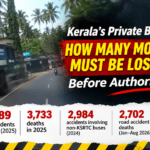
Kerala regularly witnesses serious road crashes
involving buses, motorcycles, pedestrians and
other vehicles.
Each fatal accident represents a life lost, a family
devastated and, potentially, an entirely preventable
tragedy.
Not every crash involving a private bus is necessarily
caused by its driver. Accident investigations must
establish responsibility using evidence.
However, dangerous driving practices that are
repeatedly observed on public roads demand preventive
enforcement, regardless of whether a collision has
already occurred.
The authorities should not wait for a viral video,
a public protest or a fatal accident before acting.
Road safety enforcement must be continuous,
visible and consistent.
3. Heavy Fines, Licence Cancellation and Permit Action
Kerala does not lack traffic laws. India already
has a legal framework to penalise dangerous driving,
speeding and other violations under the
Motor Vehicles Act.
The problem is whether these provisions are
implemented consistently.
What We Demand
-
Strict financial penalties:
Apply substantial statutory fines for dangerous
driving, speeding and repeated violations. -
Licence suspension or disqualification:
Habitual offenders must face action against their
driving licences through the prescribed legal process. -
Permit-related action:
Bus operators who repeatedly violate permit conditions
or applicable safety requirements must face proceedings
under the law. -
Technology-based monitoring:
Use speed monitoring, CCTV, dashcam evidence and
GPS-based fleet oversight where legally and
technically appropriate. -
Continuous enforcement:
Inspections and penalties must not be limited to
occasional drives following major accidents. -
Public accountability:
Publish enforcement statistics, including violations
detected, penalties imposed and action against
repeat offenders.
Heavy fines alone will not solve everything.
The certainty of detection and punishment is
equally important.
A driver who knows that every serious violation
could result in legal consequences is less likely
to gamble with passengers’ lives.
4. The Political Party, Trade Union and Private Bus Lobby Nexus
This is perhaps the most uncomfortable question
in Kerala’s road safety debate.
Why does aggressive driving continue despite repeated
complaints, accidents and public outrage?
Private bus operators and employees have legitimate
economic and labour interests. They also have
associations and unions, some with political
affiliations.
But political influence must never become
protection from traffic laws.
There are serious public concerns about whether
relationships between political organisations,
trade unions and transport operators weaken
enforcement.
Such concerns deserve independent investigation,
not political dismissal.
Any improper interference in police or MVD proceedings
should be documented, exposed and acted upon.
Questions the Public Deserves Answers To
- Are repeat offenders being prosecuted consistently?
- Are permit violations being pursued?
- Are officials facing pressure to avoid action against particular operators?
- What happens to complaints after they are submitted?
- Are enforcement records available for public scrutiny?
These are legitimate questions in a democracy.
Allegations of an organised nexus should be established
through records and investigations rather than treated
as proven against every operator or union.
should be powerful enough to place itself above
public safety laws.
5. Citizens Are the Real Authority, Not Political Unions
A democratic government exists to protect the rights,
safety and welfare of its citizens.
Political parties are accountable to voters.
Trade unions represent workers.
Private bus associations represent business interests.
None of them owns the roads.
Workers deserve fair wages, reasonable schedules and
safe working conditions. Operators deserve transparent
regulation and commercially workable services.
But these rights do not include the freedom to
endanger the public.
transport. Their safety must come before the electoral
interests of politicians, the bargaining power of
unions or the profits of bus owners.
This principle must guide every transport policy
and enforcement decision.
6. Why Banning Private Buses Is Not the Solution
Some social media users responding to the
Roads & Rails post suggested stopping private
bus services altogether.
That would be the wrong approach.
Private buses are an important part of Kerala’s public
transport network, particularly in areas where
alternative services are limited.
Eliminating these services without adequate replacements
would hurt ordinary commuters, students, workers and
rural communities.
The objective should be to make private bus services
safe, reliable, affordable and accountable.
That requires better route scheduling, realistic
running times, driver training, fatigue management,
effective supervision and penalties for violations.
Unrealistic schedules and intense competition may
contribute to unsafe driving incentives.
Transport authorities should examine and correct
these systemic problems without excusing
individual misconduct.
7. What Kerala’s Government, Police and MVD Must Do Now
Kerala needs a coordinated, measurable road safety
programme, not another round of announcements
after a tragedy.
Identify Repeat Offenders
Maintain records of serious violations involving
commercial passenger vehicles and take escalating
action under the law.
Make Enforcement Transparent
Publish district-wise data on inspections,
violations, penalties, licence actions and
permit proceedings.
Protect Enforcement from Political Interference
Investigate credible allegations of pressure
on officials and ensure that enforcement decisions
are based on law and evidence.
Fix Dangerous Operating Practices
Review unrealistic schedules, dangerous competition,
driver working hours and inadequate training.
Make Citizen Complaints Count
Provide accessible reporting channels,
complaint tracking and timely responses
to credible video evidence of violations.
8. The Larger Problem Is Kerala’s Enforcement Culture
Kerala’s road safety crisis is not limited
to private buses.
Footpath encroachments, dangerous overtaking,
illegal parking, failure to respect pedestrian
crossings and disregard for traffic signals
are all symptoms of a wider problem.
Rules are often treated as optional until
an enforcement officer appears.
Public awareness campaigns have their place,
but awareness without accountability achieves little.
A functioning road safety system cannot depend
on the goodwill of individual drivers.
It must be designed so that dangerous behaviour
is detected, corrected and penalised.
Conclusion: Roads Belong to the People
Kerala does not need to eliminate private buses.
It needs to eliminate dangerous driving.
It does not need more political speeches after
fatal accidents. It needs consistent enforcement
before accidents happen.
It does not need special treatment for powerful
transport associations. It needs equal application
of the law.
And it certainly does not need a system in which
citizens must risk their lives simply to travel
to work, school or home.
They are not the private property of bus operators,
political parties or trade unions.
Public safety is not negotiable.
The Kerala government, police, Motor Vehicles
Department, political leadership and transport
operators must all be held accountable for
their respective responsibilities.
Better roads. Safer transport.
Stronger enforcement. Citizens first.
Editorial note:
This article is based on the Roads & Rails social
media discussion and public-interest commentary.
It does not claim to establish the cause of any
specific accident or prove political interference
in a particular enforcement case. Current accident
statistics and specific allegations require
independent verification before publication as
established facts.