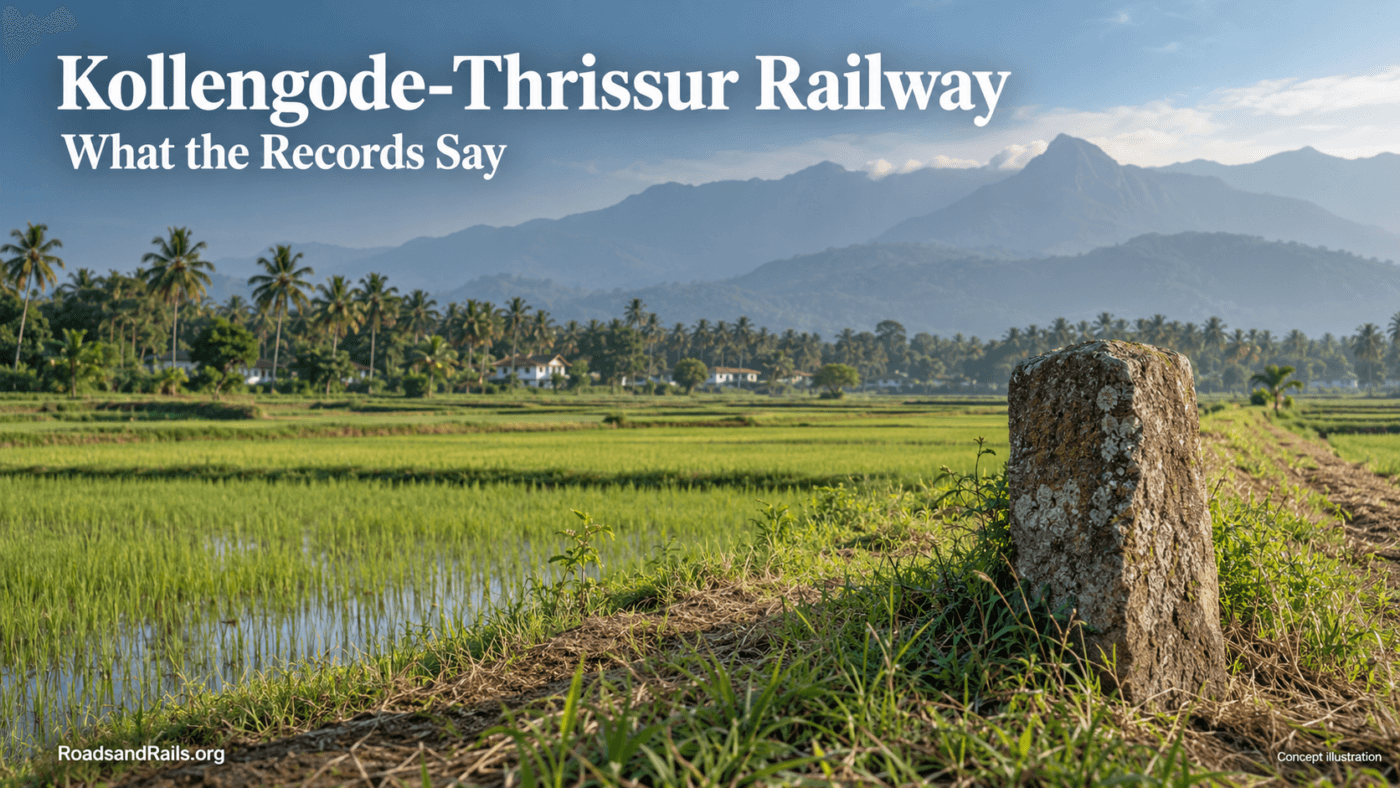
A railway survey conducted during British rule. Survey stones reportedly placed along a proposed route through Nemmara. A railway connection that remained on paper for decades.
The Kollengode-Thrissur railway proposal raises a valid question: why did a route discussed so long ago fail to become a reality?
Answering that question requires separating historical evidence, local recollections and assumptions about railway economics.
Were survey stones laid during British rule?
There is published support for this claim. An archived The New Indian Express report states that a survey for a 56-km Kollengode-Thrissur railway line was completed in 1942. Survey stones were reportedly erected along the proposed route through Nemmara, Alathur, Vadakkencherry and Mannuthy.
However, the more specific claim that stones were placed near the Boys’ High School ground in Nemmara remains unverified in the sources examined. Confirming that location would require an original survey map, an archival record or other reliable evidence.
Survey stones mark a proposed alignment. They do not establish that construction was sanctioned, funded or started.
The historical claim therefore has support, but its precise local details need further verification.
Why did the railway line fail to materialise?
The sources examined do not establish why the original British-period proposal did not proceed. Later official records, however, identify obstacles faced by subsequent proposals.
In a parliamentary reply dated 28 February 2008, the government stated that the Kollengode-Thrissur survey had been completed. It explained that the proposal could not be considered because of the substantial outstanding commitments to ongoing projects and severe resource constraints.
A Railway Board survey list dated August 2014 recorded the Kollengode-Trichur proposal as a 59-km new line, with an estimated cost of ₹301 crore and a projected rate of return of -8.45%. Its status was listed as “Completed & project shelved”. These are historical figures, not present-day estimates.
A negative projected return indicates an unfavourable financial assessment under the assumptions used in that survey. It does not establish that the route would have no public benefit.
Equally, these later assessments cannot explain, by themselves, why a proposal from 1942 failed to proceed.
Does Indian Railways earn most of its revenue from freight?
Yes. That part of the argument is correct at the national level.
According to figures published by the Ministry of Railways, Indian Railways earned the following amounts in 2023-24:
| Revenue source | Earnings |
|---|---|
| Freight | ₹1,68,293 crore |
| Passenger services | ₹70,693 crore |
Freight earnings were substantially higher than passenger earnings. These figures describe revenue, however, rather than profit.
This national revenue pattern does not prove why the Kollengode-Thrissur line was shelved. That requires evidence about the particular project, including its expected traffic, construction costs, operating costs and role in the wider network.
Railway planning involves more than ticket revenue
Financial viability matters. Public money must be spent with care. But railway investment also involves connectivity, congestion relief, alternative routes and wider social and economic needs.
A 2025 parliamentary reply explains that railway projects are assessed using factors including expected returns, traffic projections, missing links, alternative routes, capacity constraints, operational requirements, socio-economic considerations and connectivity to tourism and industry, subject to existing commitments and available funds.
This is why neither “freight earns more” nor “people want the line” is a complete argument. A credible case needs a transparent assessment of both costs and benefits.
For the Kollengode-Thrissur proposal, the useful question is whether a fresh assessment would produce a different result from the older surveys. That should be investigated rather than assumed.
Do higher-fare trains explain the missing railway line?
A claim that Railways introduces new trains on existing tracks and charges higher fares needs specific examples. The train, class, route and fare comparison must be identified before it can be checked properly.
Even if a particular fare comparison is valid, it does not establish a connection with the decision to shelve the Kollengode-Thrissur line. No such causal link was established in the records examined.
What should the public demand?
The strongest demand is for clear, accessible evidence:
- Publication of previous survey reports and proposed alignments.
- A clear explanation of the assumptions behind the financial assessment.
- An updated examination of passenger demand, freight potential and network benefits.
- A reasoned decision explaining whether the proposal merits revival.
The available evidence supports reports of a pre-Independence survey and survey stones along the proposed route. Later official records point to funding constraints and an unfavourable projected financial return.
An old survey does not guarantee that a railway line should be built. An old rejection should not end scrutiny forever either. The public deserves a transparent assessment based on relevant evidence.
Related posts:
 Palakkad-Pollachi Railway Line: Trains and Timings Passengers Actually Need
 Palakkad-Pollachi Railway Line: A ₹350-Crore Upgrade, a 94-Year History – But Are We Using It Properly?
Palakkad Junction, Shoranur & Thrissur Railway Stations: Trains, History and Kerala Rail Guide
 Palakkad Railway Division Is Shrinking Again: What Does the Mangaluru Transfer Really Mean for Passengers and Keralam?