This guide explains the technology, its limitations and its practical applications, particularly under Indian driving conditions.
1. What Is Traction Control System (TCS)?
Traction Control System is an electronic vehicle safety feature designed to reduce excessive wheelspin during acceleration.
When a driver presses the accelerator, the engine delivers power to the driven wheels. If the available tyre-to-road grip is insufficient, one or more driven wheels may spin faster than the vehicle’s actual movement would require.
This can happen on:
- Wet or slippery roads
- Loose gravel
- Muddy surfaces
- Sandy roads
- Uneven surfaces with different grip levels
- Slippery uphill sections
Traction control detects excessive driven-wheel slip and intervenes to help the tyres regain usable traction.
Important: Traction control does not create additional tyre grip. It manages the available grip more effectively.
2. How Does Traction Control Work?
Modern traction control systems typically use wheel-speed sensors associated with the Anti-lock Braking System (ABS).
The vehicle’s electronic control units continuously monitor wheel rotation and other relevant information.
Step-by-step operation
- Wheel-speed monitoring: Sensors measure the rotational speeds of the wheels.
- Slip detection: The system identifies excessive driven-wheel slip using wheel-speed information and other vehicle data.
- Engine intervention: The system may request reduced engine torque.
- Brake intervention: Depending on the vehicle, braking force may be applied to a spinning wheel.
- Traction recovery: These interventions help reduce wheelspin and improve the vehicle’s ability to use available traction.
A practical example
Imagine a front-wheel-drive car accelerating from a standstill on a wet road.
If the driver presses the accelerator aggressively, the front wheels may begin spinning without producing sufficient forward movement.
With traction control enabled, the vehicle can reduce excessive wheelspin by managing engine torque and, where supported, braking individual wheels.
The driver may notice a brief reduction in acceleration or a flashing traction control indicator.
This is generally normal system operation, not necessarily a mechanical problem.
3. What Is Electronic Stability Control (ESC)?
Electronic Stability Control is a safety system designed to help drivers maintain directional control when a vehicle begins to deviate from its intended path.
It is particularly useful during sudden steering manoeuvres, slippery cornering and certain emergency situations.
ESC compares the driver’s intended direction with the vehicle’s actual movement.
Depending on the vehicle, it uses information from:
- Steering-angle sensors
- Wheel-speed sensors
- Yaw-rate sensors
- Lateral acceleration sensors
When ESC detects a significant difference between the intended and actual direction, it can selectively brake individual wheels and reduce engine torque to help correct the vehicle’s movement.
Example: Taking a bend too fast
Suppose a driver enters a wet curve and the vehicle begins to slide towards the outside of the bend.
ESC may intervene by braking selected wheels and adjusting engine torque to help the vehicle follow the intended direction.
However, ESC cannot overcome the laws of physics. If the vehicle is travelling too fast for the available tyre grip, a crash may still occur.
ESC is also known by various manufacturer-specific names, including Electronic Stability Program (ESP), Vehicle Stability Control (VSC) and Dynamic Stability Control (DSC).
4. Traction Control vs Electronic Stability Control: What Is the Difference?
| Feature | Traction Control (TCS) | Stability Control (ESC) |
|---|---|---|
| Primary purpose | Reduce excessive wheelspin during acceleration | Help maintain directional stability |
| Main concern | Driven wheels losing traction | Vehicle deviating from its intended path |
| Typical operation | During acceleration | During unstable vehicle movement |
| Inputs | Wheel speeds and other vehicle data | Wheel speeds, steering angle, yaw and acceleration data |
| Intervention | Engine torque reduction and/or wheel braking | Selective wheel braking and/or torque reduction |
| Typical example | Wheels spinning on a wet road | Vehicle sliding during a sudden turn |
In simple terms: TCS primarily controls excessive wheelspin when accelerating. ESC helps control the direction and stability of the vehicle when it begins to skid.
These systems are complementary, not interchangeable.
5. When Should Traction Control Remain ON?
For normal public-road driving, traction control should remain enabled.
During rain
Wet roads generally offer less tyre grip than dry roads. Traction control can help reduce wheelspin during acceleration, especially when starting from a junction or accelerating uphill.
On highways
Keep traction control enabled during highway journeys. There is generally no safety benefit in disabling it for ordinary highway driving.
On winding and hilly roads
Maintain TCS and ESC functionality on hill roads and winding routes. These systems may assist when grip varies unexpectedly, although safe speed and smooth steering remain essential.
On loose gravel
For ordinary driving on gravel roads, keeping traction control enabled is generally advisable. Special off-road modes or manufacturer instructions may differ.
During everyday city driving
Even at relatively low speeds, slippery road markings, loose sand, wet surfaces and uneven grip can cause wheelspin.
There is usually no reason to disable TCS during routine commuting.
6. When Can Traction Control Be Switched OFF?
There are limited situations where temporarily disabling traction control may help.
Situation 1: A vehicle stuck in mud
When a car becomes stuck in mud, traction control may repeatedly reduce engine power as the driven wheels spin.
In some vehicles, temporarily switching off traction control may allow the limited wheelspin needed to help the vehicle move.
Situation 2: A vehicle stuck in loose sand
Loose sand can create significant rolling resistance. Some wheelspin may be necessary to maintain movement, depending on the vehicle and terrain.
However, excessive wheelspin can dig the tyres deeper into the sand.
Situation 3: A vehicle stuck in snow
Some manufacturers recommend temporarily disabling traction control when trying to free a vehicle from deep snow or when using a gentle rocking technique.
This does not mean traction control should be disabled for normal driving on snowy or icy roads.
What should the driver do?
- Stop and assess the terrain and available clearance.
- Check the manufacturer’s instructions before disabling the system.
- Use gentle accelerator inputs and avoid excessive wheelspin.
- Try a suitable low-speed recovery method if safe.
- If the vehicle remains stuck, use appropriate recovery assistance.
- Switch traction control back ON once normal driving resumes.
Warning: On some vehicles, pressing the TCS OFF button also reduces or disables parts of the stability control system. Other vehicles provide separate TCS and ESC settings. The exact behaviour depends on the manufacturer and model.
Do not assume that disabling traction control is harmless or that it always improves mobility.
7. Understanding the Traction Control Dashboard Symbol
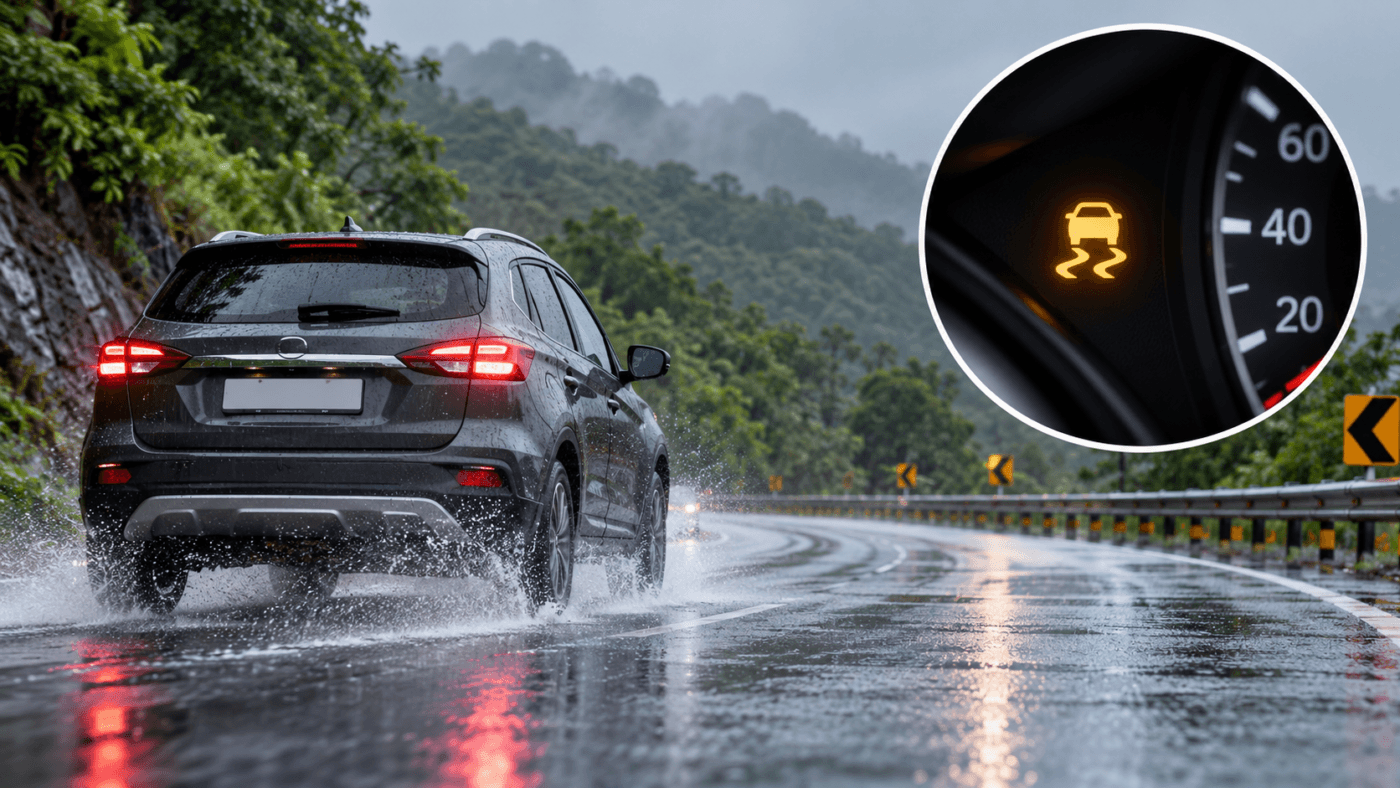
The common traction and stability control symbol resembles a car with two curved skid marks underneath it.
Flashing indicator
A flashing symbol commonly indicates that traction control or stability control is actively intervening.
This may occur during acceleration on a slippery surface or during a stability-control intervention.
Steady indicator
A continuously illuminated warning symbol may indicate a fault, depending on the vehicle.
Some vehicles also display a steady indicator when the system has been manually disabled.
TCS OFF or ESC OFF
A dedicated OFF indicator generally means that the corresponding system has been disabled or its operation has been reduced.
Consult the owner’s manual because dashboard symbols and their meanings differ between vehicles.
If a warning light remains illuminated unexpectedly, have the system checked by a qualified technician.
8. TCS, ESC and ABS: Three Different Safety Functions
Modern vehicles often integrate three important electronic safety technologies:
ABS: Anti-lock Braking System
ABS helps prevent wheels from locking during braking, allowing the driver to retain steering control more effectively in many emergency braking situations.
ABS does not guarantee a shorter stopping distance on every surface.
TCS: Traction Control System
TCS helps reduce excessive driven-wheel slip during acceleration.
ESC: Electronic Stability Control
ESC helps maintain directional stability when the vehicle begins to deviate from the driver’s intended path.
| System | Main function | Typical situation |
|---|---|---|
| ABS | Helps prevent wheel lock during braking | Emergency braking |
| TCS | Reduces excessive wheelspin | Acceleration on slippery roads |
| ESC | Helps correct directional instability | Skidding or loss of directional control |
These systems frequently share sensors and hydraulic braking components, but they address different driving risks.
9. Why TCS and ESC Matter on Indian Roads
Indian road conditions can change rapidly, making electronic vehicle safety systems particularly valuable.
Monsoon driving
Rainwater, road contamination, worn surfaces and standing water can reduce tyre grip. Drivers should reduce speed, increase following distance and avoid sudden acceleration or steering.
Traction control can help manage wheelspin, but it cannot prevent aquaplaning when tyres lose effective contact with the road surface.
Loose sand and gravel
Sand and gravel deposited near road edges, junctions or construction areas can reduce traction unexpectedly.
Sharp bends and sudden obstacles
ESC can be particularly useful when a driver makes an abrupt steering correction and the vehicle begins to lose directional stability.
Uneven road surfaces
When the driven wheels encounter surfaces with different grip levels, traction control may help limit excessive wheelspin.
However, no electronic safety system can compensate for badly worn tyres, reckless speed or unsafe driving behaviour.
10. Common Myths About Traction Control
Myth 1: Turning off TCS makes the car faster
Reality: Disabling TCS permits more wheelspin. In certain controlled performance situations this may be desirable, but excessive wheelspin can reduce acceleration and vehicle control. It offers no general advantage for public-road driving.
Myth 2: TCS should be turned off during rain
Reality: Traction control should normally remain ON during wet-weather driving.
Myth 3: ESC and TCS are the same
Reality: TCS manages excessive driven-wheel slip during acceleration. ESC addresses directional instability. They often work together but perform different functions.
Myth 4: Traction control prevents all skidding
Reality: TCS does not prevent every type of skid. ESC can assist with directional instability, but neither system can overcome inadequate tyre grip or excessive speed.
Myth 5: A car with ESC cannot overturn
Reality: ESC can reduce certain loss-of-control risks but cannot eliminate rollover risk, especially during extreme manoeuvres or when a vehicle trips over a kerb or roadside obstacle.
Myth 6: Turning off TCS also turns off ABS
Reality: This is not generally true. However, system configurations differ, so drivers should consult the vehicle’s manual rather than assume how the controls interact.
11. Frequently Asked Questions
Should traction control always be ON?
Yes, for normal road driving. Temporary deactivation may be useful in specific recovery situations, such as when a vehicle is stuck in mud, sand or deep snow, if the manufacturer permits it.
Should I turn traction control off in heavy rain?
No. Keep traction control enabled. Reduce speed and avoid sudden inputs. TCS cannot prevent aquaplaning.
Does traction control reduce engine power?
It may temporarily reduce engine torque when excessive wheelspin is detected. This is an intended safety intervention, not a permanent reduction in engine performance.
What happens when traction control is switched off?
The system’s ability to limit driven-wheel slip is disabled or reduced, depending on the vehicle. This may allow greater wheelspin during acceleration.
Can I drive with the traction control OFF light illuminated?
The vehicle may still be driveable, but an important safety function may be unavailable. Re-enable the system if it was intentionally switched off. If the warning persists unexpectedly, have it inspected.
Does TCS help when climbing a steep hill?
Yes, it can help manage wheelspin when the driven wheels begin losing traction. However, tyre condition, road surface, vehicle load and available grip remain important.
Is ESC more important than TCS?
Both serve different purposes. ESC is especially important for reducing certain loss-of-control crashes, while TCS helps manage wheelspin during acceleration. Drivers should keep both operational during normal driving.
Can traction control stop a car from skidding around a bend?
TCS primarily manages wheelspin during acceleration. ESC is specifically designed to assist with directional instability during cornering and other manoeuvres.
Does traction control work without ABS?
Most modern TCS implementations share sensors and other components with ABS. A fault affecting ABS components may also affect traction control, depending on the vehicle.
Does switching off TCS improve fuel efficiency?
There is no general fuel-efficiency benefit from disabling traction control during ordinary driving. TCS normally intervenes only when excessive wheelspin is detected.
Can ESC and TCS replace careful driving?
No. These systems assist the driver within the physical limits of tyre grip. Safe speed, suitable tyres, proper maintenance and attentive driving remain essential.
12. Conclusion: Keep Your Safety Systems Enabled
Traction Control and Electronic Stability Control are not unnecessary electronic restrictions. They are important safety technologies designed to assist drivers when available tyre grip becomes insufficient.
Traction Control helps prevent excessive wheelspin during acceleration. Electronic Stability Control helps the driver maintain directional control when the vehicle begins to skid.
For ordinary driving, including highways, city traffic, wet roads and winding hill routes, both systems should normally remain enabled.
Temporarily switching off traction control may be appropriate in certain vehicle-recovery situations, but only in accordance with the manufacturer’s instructions.
The rule is simple: Keep TCS and ESC ON during normal driving. Switch off traction control only when there is a specific, justified reason.
Most importantly, electronic safety systems are aids, not substitutes for responsible driving.
Further Reading and References
- National Highway Traffic Safety Administration (NHTSA) – Vehicle safety information and electronic stability control resources.
- Insurance Institute for Highway Safety (IIHS) – Vehicle crash prevention and stability control research.
- Bosch Mobility – Information on automotive braking and vehicle dynamics systems.
Note: Vehicle controls and system behaviour vary by manufacturer and model. Always refer to the owner’s manual for vehicle-specific instructions.
Related posts:
 Road Safety in Kerala: 5 Tips for a Safer Drive on NH544
 Kerala RTO Vehicle Registration 2026: Complete Ranking of 85 RTOs
 Charting the Course for Safer Roads: Enhancing Driving Behaviour in India
 Why Are LHB Coaches in Indian Railways Jerky? A Closer Look at the Passenger Experience LHB coach jerks, Indian Railways 3AC experience, ICF vs LHB coach, train jerks India