Why Guruvayur Needs Better Railway Connectivity
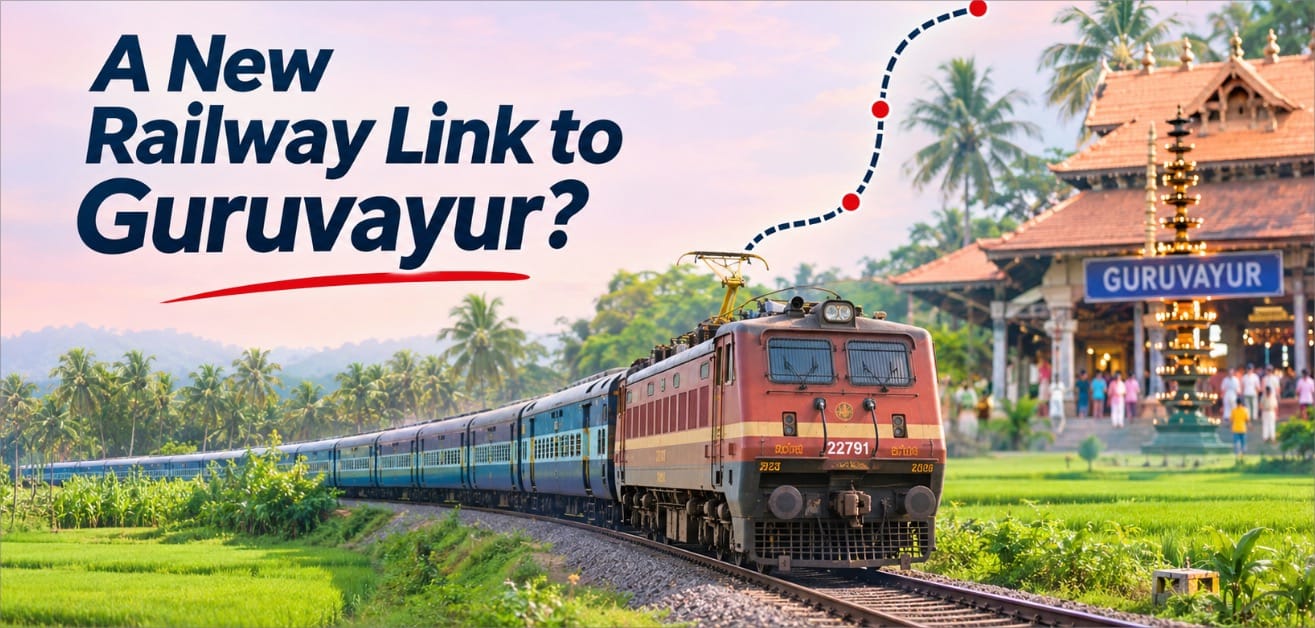
Guruvayur is one of Kerala’s major pilgrimage destinations, attracting visitors from across the state and beyond. Yet reaching the town by train remains inconvenient for many passengers travelling from northern Kerala and coastal Karnataka.
Guruvayur is connected to the railway network through the Thrissur–Guruvayur branch line. However, the absence of a direct northern railway connection means that passengers travelling from Kozhikode, Kannur, Kasaragod and Mangaluru often depend on connecting transport or indirect railway routes.
For senior citizens, families, pilgrims and passengers carrying luggage, these additional transfers can make an otherwise straightforward journey unnecessarily difficult.
Roads & Rails recently opened a public discussion about improving railway connectivity to Guruvayur. What followed was an interesting exchange of ideas, route proposals, technical concerns and differing opinions.
The discussion demonstrated something important: people are not simply asking for another railway line. They are asking for a more accessible, better-connected and future-ready transport network.
Several Routes, One Common Objective
The public discussion produced a range of suggestions. Some participants supported a new railway line from Tirunavaya, while others favoured connections from Kuttippuram, Pattambi or Tirur.
Additional suggestions included links involving Karakkad, Wadakkanchery, Punkunnam, Kollengode and Podanur.
These proposals should be understood as public suggestions, not approved railway alignments. Their technical feasibility, costs, operational benefits and environmental implications require independent assessment.
1. Tirunavaya–Guruvayur: A Direct Northern Connection
Several participants argued that Tirunavaya would be a logical starting point for a new railway connection to Guruvayur.
Their reasoning was straightforward.
Passengers from Kozhikode, Kannur, Kasaragod and Karnataka already travel along the existing coastal railway corridor. A suitable connection from Tirunavaya towards Guruvayur could provide an alternative to travelling through Shoranur and Thrissur.
Supporters also highlighted the significance of Tirunavaya and Guruvayur as religious and cultural destinations.
The Tirunavaya–Guruvayur railway proposal has a history of official consideration. However, the present status of the project, its approved alignment, if any, and its financial viability must be established from the latest Railway Ministry records.
A northern connection could have implications beyond pilgrimage travel, including regional passenger services and potential alternative train routings.
2. Kuttippuram–Edappal–Kunnamkulam–Guruvayur
Another frequently supported proposal was a railway alignment connecting Kuttippuram, Edappal, Kunnamkulam and Guruvayur.
Participants favouring this route pointed to the importance of Kuttippuram as an established railway station and the potential benefits of connecting populated areas that currently lack direct railway access.
Some suggested extending the route towards Thrissur to create an alternative corridor for north–south train movements.
One participant estimated that such a connection could save approximately 60 to 90 minutes for certain journeys by avoiding Shoranur Junction.
That estimate is a public claim, not a verified operational calculation.
Actual journey-time savings would depend on the final alignment, track geometry, permissible speeds, signalling, junction arrangements, train stopping patterns and network capacity.
Nevertheless, the underlying argument deserves attention: a well-designed new connection could potentially reduce circuitous journeys and create additional routing options.
3. Pattambi–Guruvayur: Connecting the Palakkad Region
The suggestion of a Pattambi–Guruvayur railway connection generated considerable discussion.
Supporters argued that such a line could improve access to Guruvayur from Pattambi, Shoranur, Palakkad and surrounding areas.
Critics raised two principal objections.
First, they questioned whether passengers travelling from Kozhikode and other northern districts would benefit from a route through Pattambi.
Second, they pointed to the limited space available for expanding Pattambi railway station.
Both concerns deserve examination, but neither automatically rules out the proposal.
A new railway connection does not necessarily require extensive expansion of the existing station at its present location. Depending on technical and geographical conditions, planners may examine alternative junction arrangements or connecting alignments.
Similarly, a route intended primarily to serve Palakkad and Shoranur need not be the shortest route for passengers from Kozhikode.
Different railway connections can serve different passenger markets.
The question is not whether Pattambi should replace Tirunavaya or Kuttippuram. It is whether a Pattambi connection offers sufficient additional public benefit to justify further study.
4. Tirur–Guruvayur: An Alternative Coastal Corridor?
One participant proposed a railway connection between Tirur and Guruvayur.
The argument was that such a link could help create an alternative north–south railway corridor, potentially reducing dependence on the existing route through Shoranur.
The participant suggested an approximate length of 38 kilometres for a Tirur–Guruvayur connection and compared it with a longer route through Pattambi.
These distances have not been independently verified and should not be treated as surveyed railway lengths.
The broader idea, however, is worth examining.
Kerala’s railway system is heavily dependent on a limited number of corridors and junctions. Additional connections, where technically and economically justified, could improve network flexibility.
But creating an alternative corridor requires much more than drawing a line between two stations.
Its usefulness would depend on how it connects with existing tracks, whether trains can move through the junctions efficiently, and whether the alignment provides sufficient operational capacity.
5. Karakkad–Wadakkanchery and a Punkunnam Link
A detailed contribution proposed a railway connection from Karakkad towards Wadakkanchery, along with a link north of Punkunnam to the existing Guruvayur branch.
The objective would be to improve railway access for passengers travelling from the Palakkad side.
This suggestion highlights an important operational issue.
A railway connection can appear geographically convenient but still require complex junction arrangements, land acquisition, bridges, signalling and track construction.
The participant estimated a distance of approximately 12 kilometres for one section. This figure requires verification through mapping and engineering surveys.
The same contributor also suggested considering railway connectivity from Thrissur towards Podanur through Kollengode and Velanthavalam, as well as a possible Pattambi–Kulukkallur connection in the context of the proposed Nilambur–Nanjangud railway project.
These are separate proposals with different objectives and should be evaluated independently rather than treated as components of one approved railway plan.
The Immediate Opportunity: Better Trains on Existing Tracks
New railway lines can take years or even decades to materialise.
That does not mean passengers should wait indefinitely for improved connectivity.
During the discussion, Yegneswaran PK proposed several service-level improvements that could be examined using the existing railway network.
His suggestions included:
- Introducing a direct Mangaluru–Guruvayur train through Thrissur.
- Examining whether the existing Thrissur–Kannur Express, Train No. 16609, could be extended towards Guruvayur and potentially farther north.
- Exploring the use or extension of Kannur–Shoranur services to improve Guruvayur connectivity.
- Considering a future Mangaluru–Guruvayur–Rameswaram pilgrimage service.
These are suggestions from a member of the public, not announcements of new train services.
Importantly, the existing Thrissur–Guruvayur branch creates operational constraints for through services. Train direction reversal, platform availability, terminal capacity, rake scheduling and timetable paths would all need to be examined.
Even so, improving services on existing infrastructure is a practical subject for immediate railway planning.
Long-term infrastructure development and short-term passenger improvements should proceed together.
Shoranur Junction: A Critical Part of the Debate
Several contributors referred to congestion at Shoranur Junction.
Shoranur is a major railway junction in Kerala, connecting important routes towards Palakkad, Thrissur, Kozhikode and Nilambur.
It is reasonable to examine whether additional railway connections could reduce unnecessary train movements through this junction.
However, claims that a particular new line would automatically eliminate congestion or save a fixed amount of journey time require operational evidence.
There is also an important distinction between building new railway links and increasing capacity on existing lines.
For example, a third railway line between Shoranur and Palakkad would primarily address capacity along an existing corridor. A new connection towards Guruvayur could serve additional destinations and potentially create different train routings.
These projects are not necessarily substitutes for one another.
Both types of investment may have merit depending on passenger demand, freight movements, operational bottlenecks and long-term traffic forecasts.
What About Malappuram and Manjeri?
The discussion also extended beyond Guruvayur.
One participant recalled earlier proposals and surveys for railway connectivity involving Feroke, Manjeri and Nilambur, expressing frustration that Manjeri continues to lack a railway connection.
This raises a broader development issue.
Large towns and growing population centres should not be excluded from railway planning merely because earlier proposals did not proceed.
At the same time, a previously rejected project cannot automatically be declared feasible today.
Changing population patterns, economic activity, construction costs, transport demand and engineering capabilities may justify fresh evaluation.
The right approach is to examine the earlier findings, identify why the project did not advance and determine whether circumstances now support reconsideration.
Railway planning should assess social and regional benefits alongside financial and operational viability.
Public transport infrastructure is not simply a commercial investment. It can improve access to education, employment, healthcare, tourism and economic opportunities.
Should Railway Engineers Decide Everything?
Perhaps the most important disagreement in the discussion was not about any particular railway route.
It concerned the role of ordinary citizens in infrastructure planning.
One commenter argued that asking the public for opinions was unnecessary and that railway engineers should study the matter and make the decisions.
We strongly disagree with the suggestion that public opinion has no place in this process.
Engineers are responsible for assessing technical feasibility, safety, alignment, gradients, structures and operational requirements.
Government authorities are responsible for evaluating priorities, financing, land acquisition and public policy.
But citizens are the people who use the transport system.
They understand the daily difficulties of commuting, the lack of connections between towns, the challenges faced by senior citizens and the cost of depending on alternative transport.
Citizens should first have the opportunity to express their needs and propose solutions. Government authorities and railway engineers should then evaluate those proposals objectively.
Public consultation does not replace engineering expertise. It helps ensure that technical expertise addresses real public needs.
This is how democratic infrastructure planning should function.
A Railway Route Cannot Be Selected by Popularity Alone
Public participation is essential, but it is not a substitute for professional assessment.
A railway project should be examined against measurable criteria.
| Evaluation factor | Why it matters |
|---|---|
| Passenger demand | Identifies who would use the line and how frequently |
| Route length and travel time | Helps assess journey efficiency |
| Existing network integration | Determines whether trains can operate efficiently |
| Land acquisition | Affects cost, displacement and implementation |
| Geography and engineering | Determines construction difficulty and safety |
| Environmental impact | Identifies ecological and social consequences |
| Construction and operating costs | Establishes financial requirements |
| Regional development | Measures wider benefits to communities |
| Future capacity | Ensures the infrastructure can meet long-term demand |
No single factor should determine the outcome.
A shorter alignment is not automatically better. A route passing through more towns is not automatically more useful. And an existing large station is not necessarily the best location for a new junction.
The appropriate decision requires a comparative feasibility study.
The Bigger Question: Why Must Citizens Keep Demanding Basic Connectivity?
Some participants dismissed the discussion as unrealistic or described the proposals as daydreaming.
But almost every major infrastructure development begins with someone identifying a need and proposing a solution.
That does not mean every proposal is feasible or deserves construction.
It means that ideas should be evaluated rather than dismissed without examination.
The absence of an immediate government proposal should not prevent citizens from discussing future infrastructure.
Nor should the fact that a project may take decades discourage public advocacy.
A railway line built twenty years from now may serve generations of passengers who are children today.
Development planning must look beyond immediate political cycles.
What Roads & Rails Recommends
Based on the public discussion, Roads & Rails believes the following approach deserves serious consideration.
1. Document Passenger Demand
Establish the number of people travelling between Guruvayur and northern Kerala, Palakkad, coastal Karnataka and other relevant regions.
2. Examine Immediate Train-Service Improvements
Study whether direct or extended services can operate over existing tracks, with the necessary operational arrangements at Thrissur and Guruvayur.
3. Establish the Current Official Status of the Tirunavaya–Guruvayur Project
The public deserves clarity about previous surveys, government decisions, obstacles and the conditions required for further progress.
4. Commission a Comparative Assessment of Alternative Alignments
Where there is sufficient preliminary justification, examine the Kuttippuram, Pattambi, Tirur and other suggested connections on common technical and economic criteria.
5. Include the Public in the Planning Process
Railway passengers, local communities, businesses, local bodies and civic organisations should have meaningful opportunities to submit suggestions and concerns.
6. Publish the Findings
Infrastructure decisions should be based on transparent evidence rather than speculation, political pressure or unsupported claims.
Conclusion: The Goal Is Better Connectivity, Not Victory for One Route
The discussion revealed strong support for better railway access to Guruvayur, but no consensus on the ideal alignment.
That is not a weakness.
It is precisely why public discussion and professional feasibility studies are necessary.
Supporters of Tirunavaya, Kuttippuram, Pattambi, Tirur and other routes are raising different regional needs.
Those needs deserve to be heard.
Roads & Rails does not argue that one particular alignment must be selected before the alternatives are properly examined.
Our position is simple:
Let citizens express their needs. Let engineers evaluate the possibilities. Let governments make transparent, evidence-based decisions. And let future generations benefit from the infrastructure we have the foresight to plan today.
We should not stop imagining better connectivity simply because a project appears difficult or distant.
Progress begins when people recognise a problem, demand a solution and continue asking for accountability.
Join the Discussion
Which railway connection would provide the greatest benefit to Guruvayur and the surrounding regions?
Should the priority be a new northern railway line, better train services on existing tracks, or both?
Share your suggestions, local knowledge and practical concerns in the comments.
Roads & Rails
Better Connectivity. Better India.
www.roadsandrails.org
YouTube |
Facebook |
Instagram |
X
Editorial note: This article summarises public suggestions and discussion. Proposed route lengths, journey-time savings, historical claims and technical feasibility have not been independently verified unless specifically identified. The routes discussed should not be interpreted as sanctioned railway projects.
Related posts:
 Palakkad Junction, Shoranur & Thrissur Railway Stations: Trains, History and Kerala Rail Guide
 Palakkad, Shoranur & Thrissur Railway Stations | Complete Guide
Palakkad-Pollachi Railway Line: Trains and Timings Passengers Actually Need
 Palakkad-Pollachi Railway Line: A ₹350-Crore Upgrade, a 94-Year History – But Are We Using It Properly?