Kerala’s Private Bus Menace: How Many More Lives Must Be Lost Before Authorities Act?
Kerala’s roads are becoming increasingly dangerous for ordinary commuters, with reckless driving, dangerous overtaking and competitive racing by some private bus operators posing a serious threat to public safety. Repeated accidents and fatalities raise a fundamental question: Are the authorities doing enough to enforce existing traffic laws and prevent avoidable deaths?
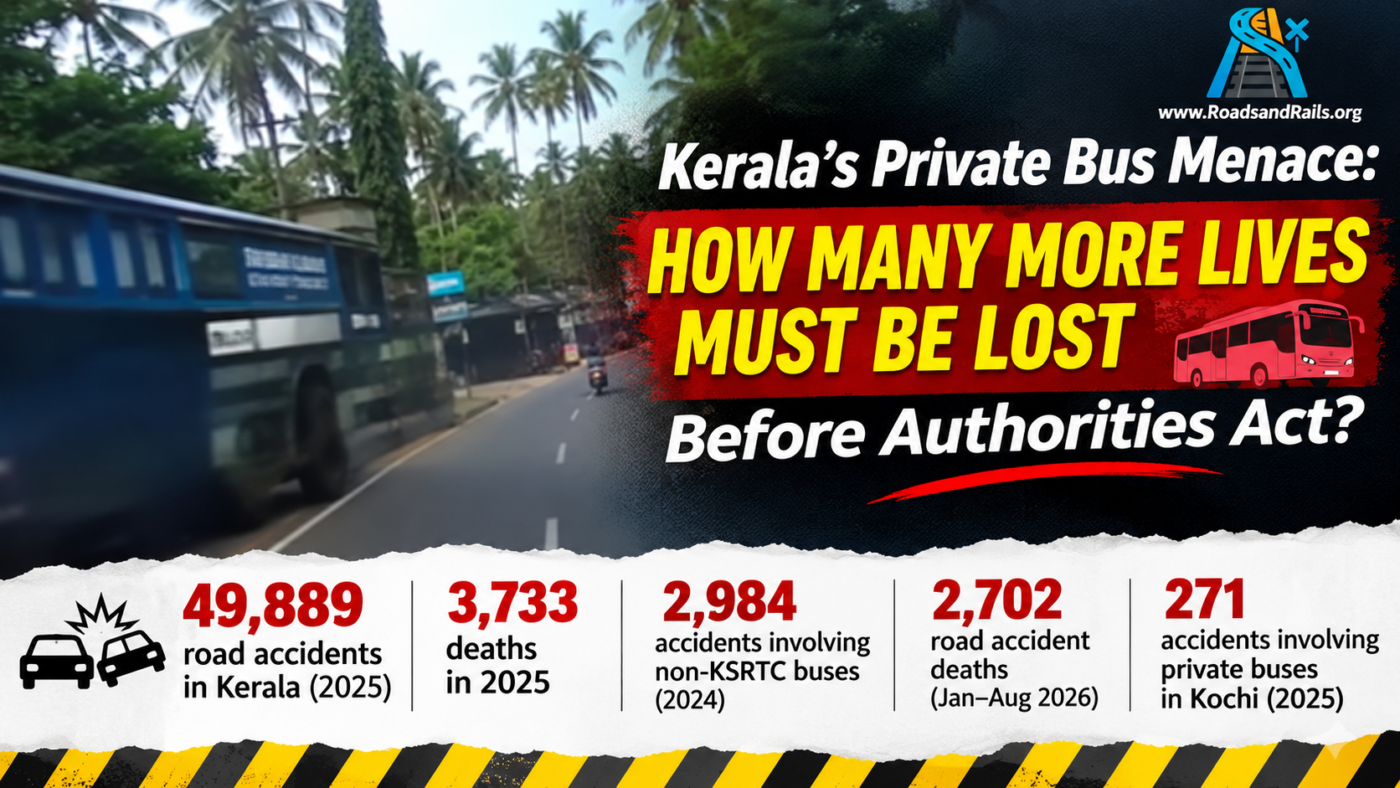
A recent video shared by Manorama Online reportedly shows a bus being driven dangerously near a scooter rider at Kattachira, Kerala. The footage highlights a disturbing issue that road users across the state have repeatedly complained about: buses being driven as though reaching the next stop on time matters more than the safety of everyone else.
Watch the original Manorama Online video on Instagram
This is not an argument against public transport. Kerala needs reliable, affordable and efficient bus services. But public transport cannot be allowed to operate at the expense of public safety.
A permit to carry passengers is not a licence to endanger other road users.
Kerala’s Road Accident Crisis: What the Numbers Reveal
The accident figures reported for Kerala paint a worrying picture.
| Period | Reported Figure |
|---|---|
| 2025 | 49,889 road accidents |
| 2025 | 3,733 road accident deaths |
| 2024 | 2,984 accidents involving non-KSRTC buses |
| January-August 2026 | 2,702 road accident deaths |
| Kochi, 2025 | 271 accidents involving private buses |
These figures need to be interpreted carefully. The statewide accident and death totals cover all categories of vehicles, not buses alone. Similarly, an accident involving a bus does not automatically establish that the bus driver was responsible.
Nevertheless, the reported number of accidents involving non-KSRTC buses warrants serious investigation into driving behaviour, enforcement, vehicle safety and operator accountability.
Data note: The figures are drawn from previously reported Kerala Police, Kerala State Planning Board and news data. Individual figures, particularly the 2024 non-KSRTC bus total, should be cross-checked against the original statistical tables before publication.
Recent Tragedies Underline the Urgency
Kakkanad, Kochi: Young Woman Killed by Private Bus
On 4 November 2026, Akshara A, a young woman from Thrissur residing in Kakkanad, was reportedly killed after a private bus struck her on the Kakkanad-Infopark Road.
According to a police FIR reported by The New Indian Express, the bus was allegedly being driven at high speed in a manner that endangered human life. Police arrested the driver and registered a case under Section 105 of the Bharatiya Nyaya Sanhita.
The allegation remains subject to the legal process.
Source: The New Indian Express
Kottayam: Private Bus Mounts Pavement
On 9 October 2026, a private bus reportedly mounted a pavement at Chanthakkavala in Kottayam, injuring pedestrians.
The following day, 18-year-old Anjali died from her injuries. Four other victims were reported to be in critical condition at the time.
The incident raises serious questions about pedestrian protection, driver control and the enforcement of traffic regulations.
Kochi: 271 Private Bus Accidents in One Year
According to city police data reported in February 2026, private buses were involved in 271 accidents during 2025, with 16 fatalities.
That is a substantial public-safety concern in one city alone.
Source: The New Indian Express
The Problem Goes Beyond Individual Drivers
Reckless driving is ultimately the responsibility of the person behind the wheel. But enforcement must also examine the operating conditions that encourage dangerous behaviour.
Several factors deserve investigation:
- Competitive scheduling and pressure to maintain trip timings.
- Dangerous overtaking to reach bus stops ahead of competing services.
- Inadequate monitoring of driving behaviour.
- Insufficient driver training and safety awareness.
- Weak accountability for repeat violations.
- Failure to ensure proper functioning of vehicle safety equipment.
When two buses compete for passengers, road users should not become unwilling participants in that competition.
A safe public transport system requires more than punishing drivers after accidents. It requires operators, transport authorities and enforcement agencies to prevent dangerous practices before someone is injured or killed.
Kerala High Court Has Already Identified the Need for Reform
In September 2026, the Kerala High Court reportedly directed the government to strengthen electronic road-safety enforcement, identify high-risk urban roads and expand camera monitoring to accident-prone stretches.
The court also reportedly directed the Transport Commissioner to convene a meeting involving private bus operators and relevant agencies to develop a technologically feasible and safe regulatory schedule for private buses.
This makes one point particularly clear: unsafe bus scheduling is not merely a complaint from frustrated motorists. It is a regulatory issue requiring serious attention.
The authorities must publicly explain the progress made in implementing these directions.
Source: The New Indian Express
Six Urgent Demands to the Kerala Government
1. Permanent Enforcement, Not Temporary Inspection Drives
Traffic enforcement must be consistent throughout the year. Dangerous overtaking, speeding, signal violations and aggressive driving should attract prompt, proportionate legal action.
Short-lived enforcement drives following major accidents are not a substitute for continuous monitoring.
2. Accountability for Bus Operators
Drivers should not be the only people investigated when unsafe operating practices are identified.
Bus owners and operators must be held accountable wherever their actions or failures contribute to violations.
3. Review Unrealistic Bus Schedules
The Motor Vehicles Department and transport authorities should examine whether route timings encourage competition or make lawful driving impractical.
Unsafe schedules must be corrected through a transparent, evidence-based process.
4. Use Technology Effectively
Authorities should verify the proper functioning of speed governors and use GPS data, camera evidence and electronic enforcement systems where legally authorised and technically feasible.
Technology must produce measurable safety improvements, not simply more equipment purchases.
5. Act Against Repeat Offenders
Repeated serious violations should trigger closer scrutiny and, where legally justified, suspension or cancellation proceedings involving driving licences or vehicle permits.
Enforcement should be based on documented violations and due process.
6. Publish Bus Accident and Enforcement Data
The public deserves access to regularly updated information on:
- Bus-related crashes and fatalities.
- Injuries involving pedestrians, cyclists and two-wheeler riders.
- Traffic violations involving passenger buses.
- Penalties imposed and enforcement actions taken.
- Repeat offenders and permit-related proceedings.
- Progress on road-safety improvement measures.
Transparency will help distinguish operators who follow the law from those who repeatedly disregard it.
Public Transport Deserves Priority, Not Immunity
Many countries give buses priority through dedicated lanes, signal priority and carefully designed transport infrastructure.
But priority is not permission to violate traffic laws.
Kerala must encourage public transport because it reduces dependence on private vehicles and improves mobility. At the same time, buses must operate within the same fundamental road-safety framework as other vehicles.
Passengers deserve safe journeys. Pedestrians deserve safe pavements. Cyclists and two-wheeler riders deserve to use public roads without being intimidated by large vehicles.
These are basic expectations, not unreasonable demands.
How Many More Deaths Before Meaningful Action?
The Kerala Police’s official statistics report that the state recorded 49,889 road accidents and 3,733 deaths in 2025.
During the first eight months of 2026, another 35,873 accidents and 2,702 deaths were recorded.
These are deaths across all road-user categories. The numbers do not establish that private buses are responsible for the majority of accidents.
However, the separate bus-specific statistics show that unsafe bus operations deserve targeted attention.
The state cannot continue treating road deaths as an unavoidable consequence of mobility.
Every preventable death raises questions about enforcement, infrastructure, driver behaviour and institutional accountability.
Governance is not about issuing condolences after an accident. It is about enforcing laws and fixing unsafe systems before accidents happen.
The Kerala Government, Transport Department, Motor Vehicles Department and Kerala Police must act together to make bus operations safer.
The public deserves measurable results, not another round of announcements.
Enough of the reckless racing. Enough of the excuses. Protect human lives.
What Has Been Your Experience on Kerala’s Roads?
Have you witnessed dangerous overtaking, aggressive driving or competitive racing involving private buses in Kerala?
Share the location, route and details in the comments. Where possible, report serious violations to the Kerala Police or Motor Vehicles Department through their official channels.
Public participation, documented evidence and consistent enforcement can help make our roads safer.
Sources and References
- Kerala Police – Official Road Accident Statistics
- Kerala State Planning Board – Economic Review 2025
- The New Indian Express – Private Bus Accidents in Kochi
- The New Indian Express – Kerala High Court Road-Safety Directions
- The New Indian Express – Kakkanad Private Bus Fatality
- Onmanorama – Kottayam Bus Crash
- Manorama Online – Kattachira Video
Roads & Rails
www.roadsandrails.org
Better Infrastructure. Better Behaviour.
Related posts:
 Comparison: Metro Rail, Tram Services, Subway Train, and Bus Services in a Busy City
 Traction Control vs Electronic Stability Control: How They Work and When to Turn Them Off
 Road Safety in Kerala: 5 Tips for a Safer Drive on NH544
 30 New MEMU Rakes, None for Kerala? Why the Reported Allocation Raises Serious Questions