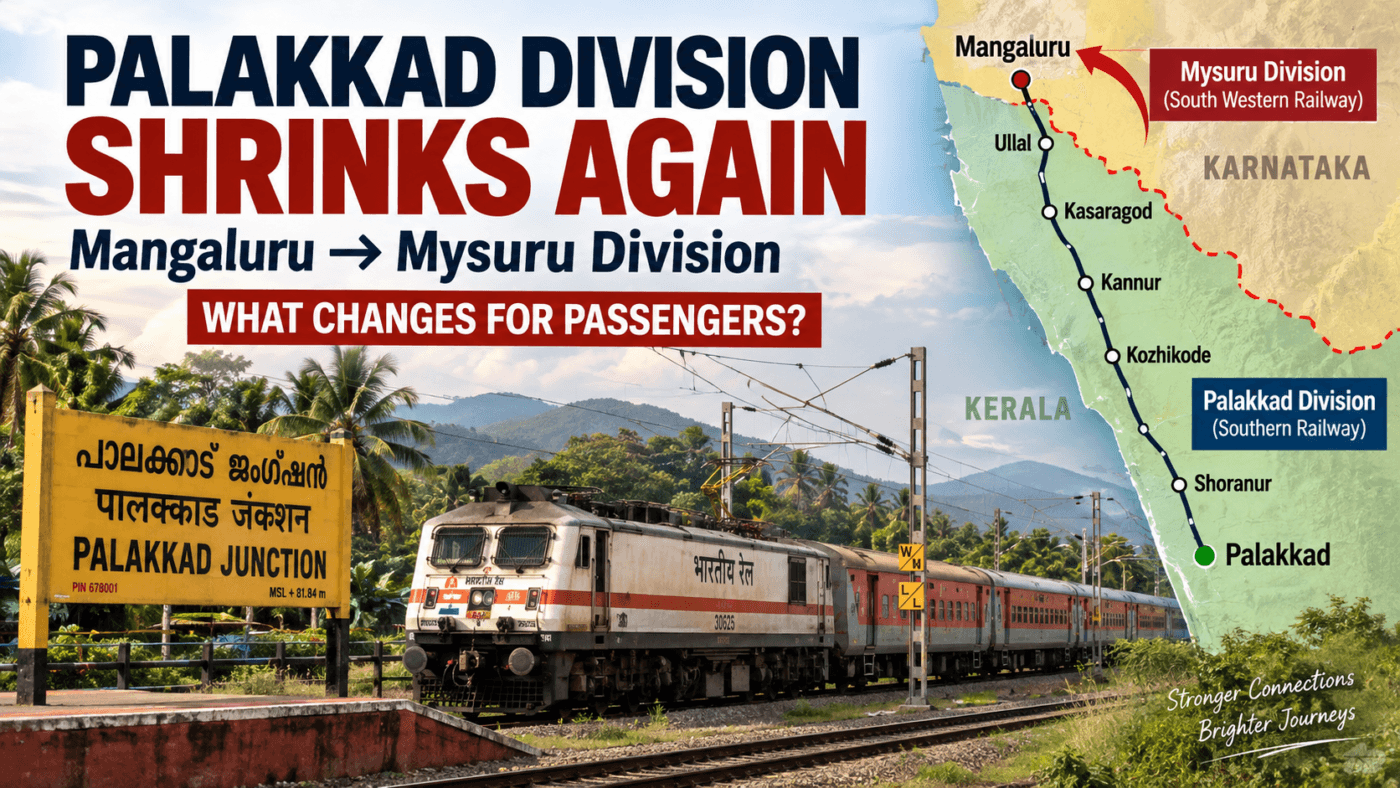
Palakkad Railway Division is not being divided into two new railway divisions. The Mangaluru railway area currently under Palakkad Division is being transferred to Mysuru Division of South Western Railway.
The distinction is important because changing a railway divisional boundary does not automatically mean cancellation of trains, removal of stops or withdrawal of passenger facilities.
What exactly has the Railway Board decided?
The Railway Board issued its order on 21 August 2026 reorganising railway jurisdiction in the Mangaluru area. The revised arrangement is scheduled to take effect from 1 October 2026.
Under the reorganisation, the Mangaluru railway area, including important railway assets such as Mangaluru Central, Mangaluru Junction, marshalling and freight facilities, is to move from Palakkad Division of Southern Railway to Mysuru Division of South Western Railway.
The jurisdictional boundary between the two divisions consequently shifts towards Ullal.
This is therefore a confirmed administrative and operational reorganisation, rather than merely a proposal being discussed.
Why does Indian Railways say the change is necessary?
According to the Railway Board and South Western Railway, the main reason is operational efficiency.
The Mangaluru railway network currently involves multiple railway administrations, including Southern Railway, South Western Railway and Konkan Railway Corporation.
Railway authorities argue that multiple operational jurisdictions within a relatively compact but busy railway network complicate train control, interchange and freight operations.
They have also pointed out that Mangaluru is more than 350 km from the Palakkad divisional headquarters, while the Mangaluru-Hassan-Mysuru-Bengaluru corridor is already under South Western Railway.
The Railway administration’s case is therefore that placing the Mangaluru area under a more unified operational jurisdiction could improve coordination of passenger and freight operations.
Is Kerala losing railway stations?
According to the Railway Board, no.
The Board has stated that the reorganisation does not transfer railway stations located inside Kerala to South Western Railway.
Palakkad Division will continue to administer its railway territory within Kerala, including stations across northern and central parts of the state that currently fall under the Division.
The transferred Mangaluru railway assets are geographically located in Karnataka.
Therefore, describing the decision simply as “Kerala railway stations being handed over to Karnataka” would not accurately represent the reorganisation.
Then why is the transfer important?
Because the importance of a railway division cannot be measured simply by counting stations or kilometres of track.
Railway divisions depend on operational assets such as:
- major terminals
- coaching depots
- pit lines
- stabling lines
- freight yards
- goods sheds
- wagon maintenance facilities
- crew facilities
- locomotive facilities
- commercial and freight traffic
The Mangaluru region contains several such facilities.
What important railway infrastructure does Mangaluru have?
According to reports based on railway officials, Mangaluru Central has six platforms and three pit lines, along with a coaching depot, sick line and running-room facilities.
The coaching depot reportedly maintains 17 pairs of trains.
Mangaluru Junction also has significant operational infrastructure, including passenger and freight lines, a sick line, wagon maintenance facilities, a diesel locomotive fuelling facility and running rooms.
This explains why the transfer is more significant than simply changing a divisional boundary on a railway map.
Palakkad Division is losing administrative control over a substantial operational base.
What about Mangaluru’s freight revenue?
This is one of the most widely discussed aspects of the controversy, but the numbers need to be presented carefully.
Media reports quoting railway officials and political representatives have claimed that the Mangaluru area generates more than 90% of Palakkad Division’s freight revenue, estimated at around ₹650 crore, and more than half of its overall annual revenue, reported at around ₹1,650 crore.
These figures should be treated as reported estimates rather than figures established by the Railway Board’s reorganisation order itself.
The Railway Board has also made an important counterargument: railway infrastructure investment is based on network requirements and is not simply allocated according to the revenue earned by an individual railway division or zone.
Therefore:
Loss of accounting revenue attributed to Palakkad Division does not automatically mean an equivalent loss of railway investment in Kerala.
However, losing major freight and operational assets can still reduce the operational footprint of a railway division. These are two different issues and should not be confused.
Palakkad Division has already become smaller before
This is not the first major reduction in the jurisdiction of Palakkad Railway Division.
Palakkad Division was formed on 31 August 1956.
Before the creation of Thiruvananthapuram Division, Palakkad Division reportedly had approximately 1,247.58 route km.
When Thiruvananthapuram Division was formed in 1979, the Shoranur-Cochin Harbour Terminus section was transferred from Palakkad.
Another major reorganisation came with the formation of Salem Division in 2007.
Historical divisional information records Palakkad Division at approximately 577.74 route km following that reorganisation.
The present Mangaluru transfer therefore needs to be viewed against a longer history of reductions in Palakkad Division’s geographical jurisdiction.
1. Will existing trains be cancelled?
There is currently no evidence that existing trains will be cancelled simply because the divisional boundary is changing.
A railway division is primarily an administrative and operational unit.
Indian passenger trains routinely operate through multiple railway divisions and railway zones during a single journey.
Changing the division responsible for a section of railway does not automatically cancel trains operating through that section.
Officials involved in the Palakkad-Mysuru transition have also stated that the intention is to ensure that passengers are not affected and train operations continue normally during the transition.
Individual trains can always be modified, extended, curtailed or cancelled by Indian Railways for separate operational or commercial reasons. But such decisions should not be automatically attributed to this divisional reorganisation.
2. Will trains stop halting at Palakkad Junction?
There is no evidence of this either.
A train’s stoppage at Palakkad Junction is determined by its timetable and operational and commercial considerations.
Nothing in the Mangaluru jurisdictional change itself directs Indian Railways to remove existing Palakkad Junction stops.
Therefore, the claim that “Palakkad Division is becoming smaller, so trains will stop calling at Palakkad Junction” is not supported by the available evidence.
3. Will ordinary passengers immediately lose facilities?
No immediate withdrawal of existing passenger facilities within Kerala has been established as a direct consequence of the boundary change.
Railway tickets and reservations are not restricted by divisional boundaries.
A passenger travelling between Palakkad and Mangaluru does not need to be concerned about crossing from one railway division or zone into another. Long-distance trains already cross several railway zones routinely.
The more important concern is therefore long-term operational capacity, rather than an immediate change to ticketing or existing passenger services.
4. Will the change prevent new trains from starting at Palakkad?
No. There is no such automatic restriction.
However, this question exposes the most important practical issue in the entire debate.
Introducing an originating train requires much more than an available platform.
Depending on the service and maintenance arrangement, railway infrastructure may include:
- pit lines
- stabling lines
- coach examination facilities
- cleaning facilities
- watering facilities
- electrical and mechanical maintenance
- Brake Power Certificate facilities
- crew facilities
- yard capacity
Therefore, losing access to major coaching and maintenance infrastructure at Mangaluru makes the development of equivalent or additional facilities within the remaining Palakkad Division strategically important.
Palakkad Town pit lines could become crucial
There is an important development on this front.
As of August 2026, work on the first pit line at Palakkad Town was reported to be nearing completion, while a second pit line had also been sanctioned.
This infrastructure could significantly improve Palakkad’s ability to maintain trains locally and support additional originating or terminating services.
Railway experts have consequently argued that the present reorganisation should become an opportunity to strengthen railway infrastructure inside Kerala rather than focusing exclusively on the loss of territorial jurisdiction.
Track capacity is another major constraint
Pit lines alone will not solve the problem.
Railway officials reported in June 2026 that the Shoranur-Podanur section was operating at nearly 100% track occupancy, while the Shoranur-Mangaluru corridor was operating at around 90%.
Such high utilisation leaves limited paths for additional trains.
Palakkad Division has consequently been undertaking capacity enhancement works including new loop lines, holding yards, signalling improvements and works aimed at increasing the maximum permissible speed on parts of the Shoranur-Mangaluru corridor.
This demonstrates an important point:
The future of new trains depends more on track capacity, terminal capacity, maintenance infrastructure and Railway Board decisions than simply on the geographical size of Palakkad Division.
5. Is this mainly a railway employees’ problem?
No.
Railway employees are certainly among those directly affected because the transfer involves staff, posts, workplaces, administrative control and organisational arrangements.
But the larger issue concerns railway planning.
The transfer affects a combination of:
territorial jurisdiction + terminals + freight operations + coaching facilities + maintenance assets + employees + administrative control.
It is therefore reasonable for passengers and railway users to examine its long-term consequences.
Does the transfer mean Palakkad Division will eventually disappear?
There is currently no official Railway Board decision stating that Palakkad Division will be abolished or merged with another division.
Some railway officials, passenger organisations and political representatives quoted in media reports have expressed fears about its future after losing Mangaluru’s operational and revenue base.
Those concerns may justify scrutiny, but they should not be presented as an established Railway Board plan.
Unless an official order is issued, claims that “Palakkad Division will soon be abolished” remain speculation.
What should Kerala demand now?
Instead of allowing the debate to remain limited to slogans about the “size” of Palakkad Division, railway users should ask measurable questions.
1. Publish the post-reorganisation map and statistics
Indian Railways should clearly publish Palakkad Division’s route kilometres, stations, freight facilities, coaching infrastructure and operational assets after the reorganisation.
2. Complete both Palakkad Town pit lines
The first pit line should be commissioned without delay and a clear completion schedule should be published for the sanctioned second pit line.
3. Develop a full-fledged coaching and maintenance facility
Palakkad Division needs sufficient facilities for maintaining, originating and terminating additional passenger trains without excessive dependence on facilities outside its jurisdiction.
4. Expand stabling capacity
Palakkad, Shoranur and suitable stations in northern Kerala should be examined for additional stabling and terminal infrastructure.
5. Increase line capacity
Additional passenger trains cannot simply be inserted into corridors operating close to their practical capacity. Loop lines, signalling upgrades, yard improvements and other capacity works therefore deserve equal attention.
6. Translate infrastructure into actual passenger services
New infrastructure should eventually produce measurable benefits – additional trains, better regional connectivity, improved punctuality and greater capacity to operate special services during periods of high demand.
Fact Check: What we know and what we don’t
| Claim | Evidence-based position |
|---|---|
| Palakkad Division is being divided into two new divisions | No. Mangaluru railway area is being transferred to the existing Mysuru Division. |
| The change takes effect on 1 October 2026 | Yes. This is the announced implementation date. |
| Kerala railway stations are being transferred | No, according to the Railway Board. |
| Existing trains will be cancelled | No evidence. The reorganisation itself does not require train cancellations. |
| Palakkad Junction will lose existing train stops | No evidence. |
| New trains can no longer originate at Palakkad | Incorrect. Infrastructure and track capacity are the more relevant constraints. |
| Palakkad Division loses important operational assets | Yes. Mangaluru has significant terminal, coaching, maintenance and freight infrastructure. |
| Palakkad Division will be abolished | No official decision establishing this has been identified. |
| Only railway employees are affected | No. Employees are directly affected, but operational and infrastructure questions are also involved. |
The real question is not how big the Division looks on a map
A geographically large railway division with inadequate infrastructure does not automatically provide better passenger services.
Likewise, a smaller division can remain operationally important if it has strong terminals, maintenance facilities, sufficient track capacity, freight activity and the ability to originate and terminate trains.
Therefore, simply demanding that Palakkad Division remain geographically large misses part of the problem.
The stronger demand should be:
After transferring major railway assets in Mangaluru, what additional operational and passenger infrastructure will Indian Railways create within Palakkad Division?
Complete the Palakkad Town pit lines.
Build adequate coaching and maintenance facilities.
Increase stabling capacity.
Improve track capacity.
Strengthen Palakkad and Shoranur as operational railway hubs.
And translate those investments into more useful passenger services.
Conclusion
The transfer of the Mangaluru railway area from Palakkad Division to Mysuru Division is significant. But its consequences should neither be exaggerated nor dismissed.
For ordinary passengers, there is currently no evidence that the administrative change itself will cancel existing trains, remove Palakkad Junction stops or prevent future trains from originating at Palakkad.
The genuine long-term concern is different.
Palakkad Division is losing administrative control over important terminal, coaching, maintenance and freight infrastructure in Mangaluru.
Whether this ultimately weakens railway development in northern Kerala will depend considerably on what Indian Railways does next.
The most important question is therefore not:
“How many kilometres did Palakkad Division lose?”
It is:
“How will Indian Railways strengthen the remaining Palakkad Division with the infrastructure required for more trains, greater capacity and better passenger services?”
That deserves a specific and measurable answer.
Roads & Rails – Better Infrastructure. Better Behaviour.
Sources & References
- Government of India, Ministry of Railways – Railway Board jurisdictional reorganisation order concerning Palakkad Division, Mysuru Division and the Mangaluru railway area, issued 21 August 2026.
- The New Indian Express, 26 August 2026 – “Keralam will not lose any stations after transfer, says Railway Board.”
- The New Indian Express, 24 August 2026 – “SWR seeks to allay Kerala fears over Mangaluru railway reorganisation.”
- The New Indian Express, 9 September 2026 – Report on the Palakkad and Mysuru divisional railway managers meeting concerning Mangaluru handover arrangements and the operational facilities at Mangaluru Central and Mangaluru Junction.
- The New Indian Express, 23 August 2026 – “Mangaluru move pushes Palakkad railway division to explore new ‘tracks’,” including information on Palakkad Town pit-line development and future coaching infrastructure.
- The New Indian Express, 18 June 2026 – Report on Shoranur-Mangaluru capacity enhancement, track occupancy, loop lines, holding yards, speed upgrades and Palakkad Town pit-line development.
- Southern Railway historical information – Palakkad Division formation and earlier jurisdictional reorganisations involving Thiruvananthapuram and Salem divisions.
Related posts:
 Why Kerala Needs a West Coast Railway Zone – And Why Palakkad Should Be Its Headquarters
 30 New MEMU Rakes, None for Kerala? Why the Reported Allocation Raises Serious Questions
 Palakkad Junction, Shoranur & Thrissur Railway Stations: Trains, History and Kerala Rail Guide
Palakkad-Pollachi Railway Line: Trains and Timings Passengers Actually Need
Palakkad Junction, Shoranur & Thrissur Railway Stations: Trains, History and Kerala Rail Guide
Palakkad-Pollachi Railway Line: Trains and Timings Passengers Actually Need