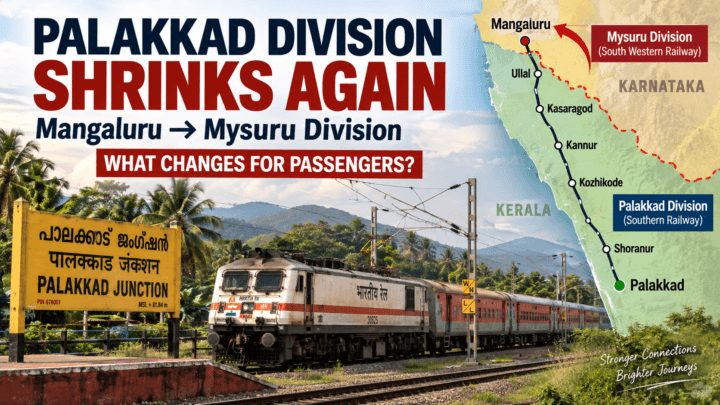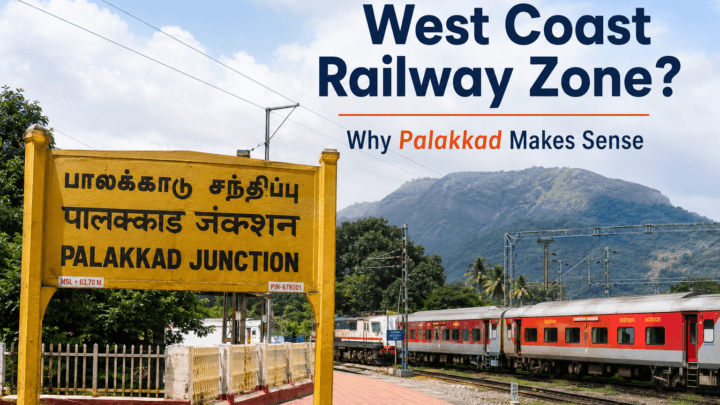
The Palakkad-Shoranur-Thrissur corridor also reveals an important chapter in the development of railways in Kerala.
Palakkad Junction: Kerala’s Eastern Railway Gateway
Palakkad Junction railway station is one of the principal railway stations serving Palakkad city.
The station is located at Olavakkode, north of the central part of Palakkad city, and its station code is PGT.
Palakkad’s railway importance is closely connected with geography.
The famous Palakkad Gap creates a major natural opening through the Western Ghats between Kerala and Tamil Nadu. For centuries, this gap helped movement between the Malabar coast and the Tamil plains.
When railway development began during the nineteenth century, this natural corridor became extremely important.
Railway lines connecting the Coimbatore region with Palakkad provided an important east-west transport link between present-day Kerala and Tamil Nadu.
According to historical information available from Southern Railway, railway development in the region included the opening of the Pattambi-Podanur section, approximately 105 kilometres long, on 14 April 1862.
This means the railway line through the wider Palakkad region existed decades before Palakkad Junction developed into the major railway centre that exists today.
Olavakkode Railway Station and Palakkad Junction: Why Two Names?
People searching online for Olavakkode railway station are usually looking for what is today called Palakkad Junction railway station.
Olavakkode is the locality in which Palakkad Junction is situated.
The station was historically known as Olavakkode Junction, and the older name remains deeply embedded in local usage.
Even today, many people in Palakkad still say:
“Get down at Olavakkode.”
They generally mean Palakkad Junction, not another railway station.
The station at Olavakkode is generally recorded as having opened in 1898, considerably later than the arrival of the railway through the wider Palakkad region in the 1860s.
This creates an interesting historical distinction:
The railway line through Palakkad is older than Palakkad Junction railway station itself.
This is also one reason the railway history of Palakkad should not be reduced simply to the history of the present Palakkad Junction station.
Why Was Olavakkode Important?
As railway traffic increased, Olavakkode developed into an important operational and administrative railway centre.
Its location allowed railway operations to connect towards Coimbatore and Tamil Nadu in the east and towards Shoranur and the wider Kerala railway network in the west.
Over time, railway facilities, operational infrastructure and residential areas associated with railway employees developed around Olavakkode.
This helped transform the area into one of the most important railway neighbourhoods in Palakkad.
For generations of railway employees and local residents, the name Olavakkode became almost synonymous with the railway.
Shoranur Junction: One of Kerala’s Most Important Railway Junctions
West of Palakkad lies another highly important railway location: Shoranur Junction.
Passengers search for it using several variations, including:
- Shoranur railway station
- Shoranur Junction
- Shoranur Junction railway station
- Shoranur station
- Shoranur railway junction
These searches generally refer to Shoranur Junction railway station, whose station code is SRR.
Shoranur occupies a strategically important location because railway routes towards different parts of Kerala converge in this area.
A passenger arriving from Palakkad can continue south towards:
Thrissur → Ernakulam → Kottayam → Kollam → Thiruvananthapuram
or travel north towards:
Kozhikode → Kannur → Kasaragod → Mangaluru
The railway connection towards the Nilambur region also branches through the Shoranur railway network.
This makes Shoranur much more than simply a railway station serving Shoranur town.
Its importance comes primarily from its position within the railway network.
Why Is Shoranur Junction So Important?
A railway junction becomes strategically important when multiple railway routes converge and trains, passengers and railway operations are redistributed across different directions.
Shoranur Junction developed precisely such a role.
For passengers travelling from Palakkad, Coimbatore or other parts of Tamil Nadu, Shoranur provides access towards both northern and southern Kerala.
Similarly, trains originating in northern Kerala often pass through Shoranur before continuing towards Thrissur, Ernakulam and southern Kerala.
For generations of passengers, Shoranur has therefore been one of Kerala’s great railway interchange points.
Its importance is not based solely on the population of Shoranur town. It is primarily a consequence of railway geography.
Thrissur Railway Station: A Major Passenger Hub
Continuing south from Shoranur brings trains to another important railway centre: Thrissur railway station.
Thrissur is one of Kerala’s major commercial, educational, cultural and tourism centres.
The city generates substantial railway passenger traffic throughout the year.
The principal railway corridor broadly follows:
Palakkad Junction → Shoranur Junction → Wadakkanchery → Thrissur → Irinjalakuda → Chalakudy → Aluva → Ernakulam
Individual trains have different stopping patterns, but geographically this is the main railway corridor connecting Palakkad with Thrissur and Ernakulam.
This is one reason Thrissur railway station, Shoranur Junction and Palakkad Junction frequently appear together in journey searches.
Palakkad to Thrissur by Train
Rail is one of the most practical modes of travel between Palakkad and Thrissur.
The railway provides a direct corridor through:
Palakkad Junction → Shoranur Junction → Thrissur
A large number of regional and long-distance trains use this section.
Depending on the timetable and operating period, services may include express trains, superfast trains, MEMU services and other passenger services.
Passengers searching specifically for an Intercity train or Intercity Express should always check the latest Indian Railways timetable before travelling.
Train numbers, stopping patterns, departure times and operating days can change.
The strength of the Palakkad-Shoranur-Thrissur corridor is not dependent on a single train. Its importance comes from the large number of passenger and freight trains using the route.
What Is an Intercity Train?
The term Intercity train generally refers to a passenger railway service intended to connect important cities over relatively short or medium distances.
Indian Railways also operates several trains that specifically carry Intercity Express in their official names.
These trains are often useful for:
- office travellers
- students
- business passengers
- short-distance intercity travel
- same-day journeys between major cities
However, passengers should not assume that every train travelling between two cities is officially an Intercity Express.
When planning a journey, search using the exact train name or train number and verify the latest timetable.
Palakkad-Shoranur-Thrissur: More Than a Passenger Corridor
The importance of this railway section is not limited to passenger trains.
The corridor forms part of a much larger railway artery carrying long-distance passenger trains and freight between Kerala, Tamil Nadu and the rest of India.
Palakkad’s location near the Palakkad Gap makes the route particularly significant.
From Tamil Nadu, the railway through Coimbatore and Palakkad provides one of the principal railway entrances into Kerala.
Once trains reach Shoranur, the network allows onward movement towards different parts of the state.
A simple way to understand the railway geography is:
Palakkad is the eastern gateway. Shoranur is the distributor. Thrissur is one of the major passenger centres further south.
Chennai Egmore and Kerala Railway Connections
Another keyword frequently associated with railway travel through this region is Chennai Egmore.
Chennai Egmore is one of Chennai’s principal railway terminals and handles numerous long-distance passenger services, particularly towards southern Tamil Nadu and neighbouring regions.
Railway connections between Chennai and Kerala have remained important for decades because of business, education, employment, tourism and family travel.
Southern Railway has operated services connecting Chennai Egmore with destinations in Kerala, including the Chennai Egmore-Guruvayur Express.
Passengers commonly search for journeys such as:
- Chennai Egmore to Shoranur
- Chennai Egmore to Thrissur
- Chennai Egmore to Palakkad
- Kerala to Chennai Egmore
- Chennai Egmore Intercity and Express trains
Passengers should always verify current train schedules through official railway sources because routes, operating days and timings can change.
The Railway History Behind Modern Palakkad
Today’s railway network across Palakkad and the former Malabar region has roots stretching back more than 160 years.
Historical information relating to the Palakkad Division provides an important chronology of early railway development:
- 12 March 1861: Beypore-Tirur railway opened, approximately 30.5 km.
- 1 May 1861: Tirur-Kuttippuram railway section opened, approximately 14.5 km.
- 14 April 1862: Pattambi-Podanur section opened, approximately 105 km.
- 23 September 1862: the remaining Kuttippuram-Pattambi section was completed.
- The railway was later extended northwards in stages towards Mangalore.
These early lines formed part of the foundation upon which the modern railway network of northern and central Kerala developed.
Palakkad Railway Division: Established in 1956
The Palakkad Railway Division was formed on 31 August 1956.
The division historically controlled a much larger railway territory than it does today.
Before the creation of the Thiruvananthapuram Division, Palakkad Division had approximately 1,247.58 route kilometres under its jurisdiction.
When the Thiruvananthapuram Railway Division was formed on 2 October 1979, the Shoranur-Cochin Harbour Terminus section was transferred from Palakkad Division.
Following this change, Palakkad Division had approximately 1,132.98 route kilometres.
Another major restructuring came with the formation of the Salem Railway Division on 1 November 2007.
After this reorganisation, Palakkad Division was reduced to approximately 577.74 route kilometres.
Despite these territorial changes, Palakkad continues to be an important administrative and operational centre of Southern Railway.
Palakkad’s Other Historic Railway Corridor: The Pollachi-Palghat Railway
Palakkad’s railway story is not limited to the main railway line towards Coimbatore and Shoranur.
Another historically important railway corridor runs south-east towards Pollachi.
A historical Madras Presidency gazetteer describes the Pollachi-Palghat Railway as approximately 33.45 miles long.
The historical account mentions stations including:
- Mudalamada
- Kollengode
- Pudunagaram
- Palghat
The gazetteer described the railway as an important feeder line that provided more direct communication between the Palghat region and the railway network towards Dindigul and southern Tamil Nadu.
It also highlighted the commercial potential of the line because it passed through populated agricultural regions and important mercantile centres.
The historical document noted that the largest bridge on the line crossed the Kannadi River.
The railway was expected to improve communication and support the development of trade across the region.
This railway history reinforces an important point: Palakkad’s importance as a transport crossroads is closely connected with its geography.
Palakkad Junction vs Palakkad Town Railway Station
Visitors to Palakkad should know that Palakkad Junction and Palakkad Town are two different railway stations.
Palakkad Junction
Palakkad Junction is located at Olavakkode.
It lies on the major railway corridor connecting:
Coimbatore → Palakkad → Shoranur → Thrissur → Ernakulam
It is the principal long-distance railway station serving Palakkad city.
Palakkad Town
Palakkad Town railway station is located closer to central Palakkad.
It is associated with the railway route towards:
Pudunagaram → Kollengode → Muthalamada → Pollachi
Passengers booking tickets should therefore carefully check whether their ticket shows Palakkad Junction or Palakkad Town.
The two stations are separate and should not be confused.
Palakkad Junction, Shoranur and Thrissur: How the Corridor Works
The railway geography becomes easier to understand if the corridor is viewed as a connected transport system.
From Tamil Nadu into Kerala
Trains approaching Kerala from the Coimbatore side enter the state through the Palakkad region.
Palakkad Junction therefore functions as one of Kerala’s most important eastern railway gateways.
At Shoranur Junction
At Shoranur, railway traffic can continue towards different directions.
Routes provide connections towards northern Kerala, southern Kerala and the Nilambur region.
Towards Thrissur and Ernakulam
Southbound services proceed from Shoranur through Wadakkanchery towards Thrissur and eventually Ernakulam and southern Kerala.
This makes the Palakkad-Shoranur-Thrissur corridor one of the most strategically important sections of Kerala’s railway network.
Why This Railway Corridor Still Matters
The Palakkad-Shoranur-Thrissur railway corridor continues to play an important role in Kerala’s economy and mobility.
It supports:
- daily passenger travel
- long-distance railway services
- interstate travel between Kerala and Tamil Nadu
- freight movement
- student travel
- business travel
- tourism
- regional mobility
The route also connects several important urban centres and railway junctions within a relatively short distance.
For this reason, improvements in capacity, station infrastructure, train frequency and timetable planning along this corridor can have benefits far beyond individual stations.
Frequently Asked Questions
Is Olavakkode railway station the same as Palakkad Junction?
Yes. Palakkad Junction is located at Olavakkode and was historically known as Olavakkode Junction. The older name is still widely used by people in Palakkad.
What is the station code of Palakkad Junction?
The station code of Palakkad Junction railway station is PGT.
Is Shoranur railway station the same as Shoranur Junction?
Yes. Searches for Shoranur railway station, Shoranur Junction railway station and Shoranur Junction generally refer to the same major railway station.
What is the station code of Shoranur Junction?
The station code of Shoranur Junction is SRR.
Why is Shoranur Junction important?
Shoranur is an important railway interchange because routes towards northern Kerala, southern Kerala, Palakkad, Tamil Nadu and Nilambur converge in the region.
Can I travel from Palakkad Junction to Thrissur by train?
Yes. Palakkad Junction, Shoranur Junction and Thrissur railway station lie on the main railway corridor connecting Palakkad with central Kerala.
Several passenger trains use this section. Check the latest timetable for services available on your travel date.
Is there an Intercity train between Palakkad and Thrissur?
Intercity, express and regional railway services operate on Kerala’s major railway corridors, but train names, frequencies and schedules can change.
Passengers should check the current Indian Railways timetable using the exact origin, destination and date of travel.
Does Chennai Egmore have trains towards Kerala?
Yes. Chennai Egmore is connected with destinations in Kerala through long-distance railway services.
Current schedules should always be verified before travelling.
Is Palakkad Town the same as Palakkad Junction?
No. Palakkad Junction and Palakkad Town are separate railway stations.
Palakkad Junction is located at Olavakkode on the main Coimbatore-Shoranur railway corridor, while Palakkad Town is on the railway route towards Pollachi.
When was the Palakkad Railway Division formed?
The Palakkad Railway Division was formed on 31 August 1956.
Three Stations, One Important Railway Story
Look at a railway map and Palakkad Junction, Shoranur Junction and Thrissur railway station may appear simply as three stops along Kerala’s railway network.
Look at their history and geography, and a much larger picture emerges.
Palakkad became Kerala’s eastern railway gateway through the natural passage of the Palakkad Gap.
Shoranur developed into one of Kerala’s most strategically important railway junctions.
Thrissur became a major passenger centre along the route towards Ernakulam and southern Kerala.
And behind today’s Palakkad Junction survives another historic railway name that generations of Palakkad residents instantly recognise:
Olavakkode.
More than 160 years after the early railway reached this region, the Palakkad-Shoranur railway corridor remains fundamental to the movement of passengers and goods across Kerala.
What Is Your Railway Memory?
Do you still call Palakkad Junction “Olavakkode”?
Which station do you associate most strongly with your railway journeys – Palakkad, Shoranur or Thrissur?
Which train on this route deserves a better timetable or increased frequency?
Have you travelled regularly on the Palakkad-Shoranur-Thrissur railway corridor?
Share your railway memories, old photographs, corrections and suggestions in the comments.
Local memories from passengers, railway employees and residents are an important part of preserving Kerala’s railway history.
Explore More Railway Stories
Roads & Rails documents railway history, railway infrastructure, train journeys, stations, railfanning locations, road transport and public transport issues from Palakkad, Kerala and beyond.
Explore more stories at:
Follow Palakkad Roads & Rails
For railway videos, station visits, railfanning, transport news and infrastructure discussions, follow our YouTube channel:
Subscribe to Palakkad Roads & Rails on YouTube
You can also follow our WhatsApp Channel for new railway and road updates:
Related posts:
 Palakkad-Pollachi Railway Line: A ₹350-Crore Upgrade, a 94-Year History – But Are We Using It Properly?
 Palakkad Junction Railway Station: The Gateway to Kerala’s Rail Network
 Road Trip Itinerary: Bangalore to Goa | Mumbai to Goa | Delhi to Goa | Kolkota to Goa | Chennai to Goa
 ChicKing Outlets Coming to 10 Kerala Railway Stations: Full Station List