Palakkad-Pollachi Railway Line: Its Real History, ₹350-Crore Gauge Conversion and the Case for Better Local Trains
The Palakkad-Pollachi railway line is one of the most important yet underutilised public transport corridors serving southern and eastern parts of Palakkad district.
It connects Palakkad Junction and Palakkad Town with Pudunagaram, Kollengode and Muthalamada before crossing the Kerala-Tamil Nadu border and continuing through Minatchipuram and Anaimalai Road to Pollachi Junction.
Today the line is broad gauge, electrified and connected to the wider Indian Railways network. A new MEMU service was introduced in March 2026, and the Union Government has also approved a Final Location Survey for doubling the larger Palakkad-Pollachi-Podanur corridor.
Yet one basic question remains:
Are we actually using this railway line effectively for the everyday travel needs of people living along it?
For residents of Kollengode, Muthalamada, Pudunagaram and surrounding areas, the issue is not simply whether trains operate on the route.
The more important question is whether useful trains are available when people actually need to travel.
First, a Historical Clarification: Palakkad Had Railways Long Before the Pollachi Line
The history of railways in Palakkad district begins much earlier than the Palakkad-Pollachi railway.
The main railway line through the Palakkad Gap was constructed by the Madras Railway Company during the nineteenth century.
According to Southern Railway’s history of the Palakkad Division, the Pattambi-Podanur section, approximately 105 km long, opened on 14 April 1862.
This connected places on the present-day Shoranur-Palakkad-Coimbatore main line.
It is important not to confuse this nineteenth-century broad-gauge main line with the metre-gauge Palghat-Pollachi branch railway, which came much later.
When Did the Palakkad-Pollachi Railway Actually Open?
There is some incorrect and conflicting information online about the opening date of this railway.
For example, Wikipedia currently lists 1904 as the opening year of Kollengode railway station and Palakkad Town railway station.
However, contemporary and official historical records do not support 1904 as the opening year of the Palghat-Pollachi railway.
The Madras District Gazetteers – Malabar provides much stronger historical evidence.
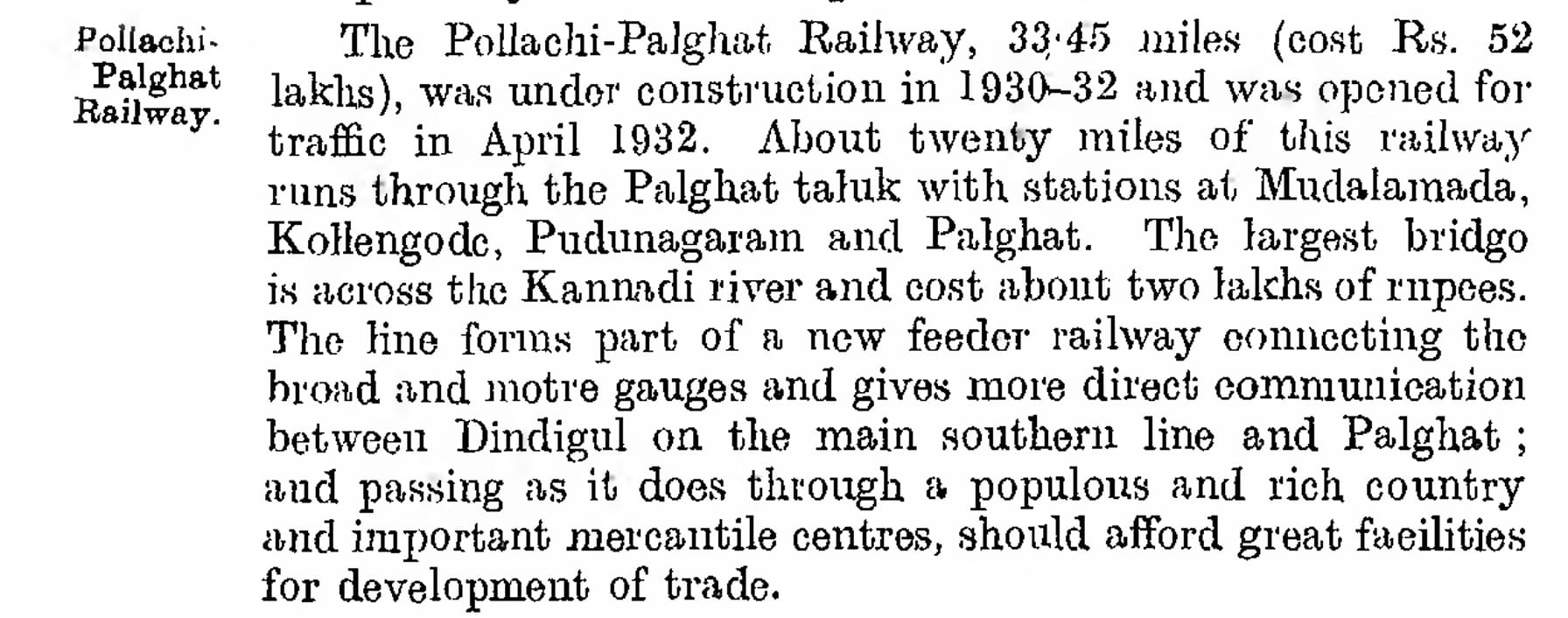
It records that the:
Pollachi-Palghat Railway, approximately 33.45 miles long, was under construction during 1930-32 and opened in April 1932.
Crucially, the same historical record explicitly states that about twenty miles of this railway ran through Palghat taluk with stations at:
- Muthalamada
- Kollengode
- Pudunagaram
- Palghat
This is strong evidence that Kollengode railway station formed part of the Palghat-Pollachi railway opened in April 1932, rather than a railway operating there from 1904.
The later Kerala District Gazetteers – Palghat independently confirms that metre-gauge lines were laid as part of the construction of the Palghat-Pollachi railway in 1932.
Therefore, unless stronger primary documentary evidence emerges showing a separate railway operation at Kollengode before 1932, 1932 is the historically defensible date for railway operation on the Palghat-Pollachi corridor through Kollengode.
Why Does Wikipedia Say Kollengode Opened in 1904?
Wikipedia currently displays:
Kollengode railway station – Opened: 1904
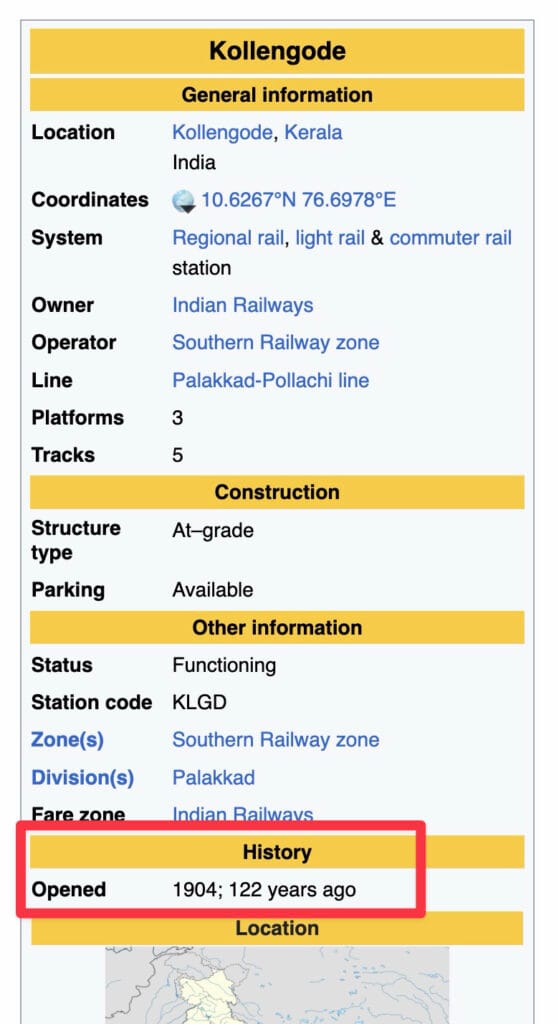
However, the citation attached to the station information primarily relates to Southern Railway’s current classification of railway stations and does not establish the historical 1904 opening date.
The same 1904 date also appears on the Wikipedia page for Palakkad Town railway station.
This appears inconsistent with historical railway gazetteers that specifically describe the Palghat-Pollachi railway as a new line constructed around 1930-32 and opened in April 1932.
Wikipedia is useful as a starting point, but for railway history, contemporary government reports, railway administration documents and district gazetteers should take precedence when the sources conflict.
The Railway Was Planned in the Late 1920s
The railway itself had been planned several years before it opened.
A Government of India railway administration report records that construction of the Pollachi-Palghat railway, approximately 33½ miles long and designed as a metre-gauge railway, was sanctioned in June 1928.
The justification for building the railway is particularly interesting today.
The proposed line was expected to serve a productive agricultural region and facilitate movement of commodities including:
- Rice
- Groundnuts
- Cotton
- Timber
- Other agricultural produce
Timber movement from the Nelliyampathy and Anamalai hill regions was also cited as an economic benefit.
So from the beginning, the railway was not conceived merely as a long-distance passenger route.
It was designed to improve the economic and transport connectivity of the communities along the corridor.
April 1932: Palghat Gets Its Railway Connection to Pollachi
The metre-gauge Palghat-Pollachi railway opened for traffic in April 1932.
The route connected Palghat with important settlements and agricultural regions south of the town before reaching Pollachi.
Stations along the Kerala side included places such as:
- Palghat
- Pudunagaram
- Kollengode
- Muthalamada
The railway then continued towards Pollachi in the Coimbatore district of the then Madras Presidency.
This substantially improved communication between the Palghat region and the major agricultural and commercial centre of Pollachi.
Connection With Olavakkot and the Broad-Gauge Main Line
Palghat itself already had access to the nineteenth-century broad-gauge railway running between Shoranur, Palakkad and Podanur.
Olavakkot, today’s Palakkad Junction, became the principal railway junction of the region.
The Palghat-Pollachi line, however, was metre gauge.
Historical records indicate that metre-gauge infrastructure was provided alongside the broad-gauge connection between Palghat and Olavakkot, enabling the Pollachi-side railway to connect with the important junction at Olavakkot.
This made the new rural branch more useful by linking it with the established main-line railway network.
A Rural Passenger Railway for Generations
For decades, the metre-gauge railway became part of everyday life in southern Palakkad district.
Passenger trains connected communities including:
- Palakkad
- Palakkad Town
- Pudunagaram
- Kollengode
- Muthalamada
- Minatchipuram
- Anaimalai Road
- Pollachi
From Pollachi, metre-gauge connections extended towards other parts of Tamil Nadu.
For people living along the line, these were not simply trains passing through their villages.
The railway functioned as an affordable local and regional public transport system.
Older residents remember a period when several passenger trains operated on the route in both directions and stopped at the smaller stations.
That local connectivity is important when evaluating today’s services.
2008: The Metre-Gauge Era Comes to an End
The old metre-gauge Palakkad-Pollachi railway eventually closed for conversion to broad gauge.
The project formed part of Indian Railways’ wider programme to eliminate metre-gauge sections and integrate routes into the national broad-gauge network.
The objective was sensible.
Broad gauge would allow trains to operate between Kerala and other parts of Tamil Nadu without the limitations created by different railway gauges.
But for local passengers, the transition came at a significant cost.
The railway remained unavailable for approximately seven years while gauge-conversion works progressed.
2015: Broad-Gauge Trains Finally Return
By 2015, major works including track laying, platforms, station buildings, signalling, bridges and level-crossing infrastructure were nearing completion.
The Commissioner of Railway Safety inspected the approximately 54.72-km Pollachi-Palakkad Town broad-gauge section in October 2015.
Passenger services resumed on 16 November 2015.
The return of trains was naturally welcomed across the region.
But a major concern soon became apparent:
The railway infrastructure had returned in a much-improved form, but the old level of useful local passenger connectivity had not.
How Much Did the Gauge Conversion Cost?
Another correction is necessary here because different figures have circulated publicly.
The Palakkad-Pollachi gauge-conversion project should not be described as a ₹600-crore project.
Official figures released by the Ministry of Railways in 2026 list:
- Pollachi-Palghat gauge conversion – 56 km – ₹350 crore
- Pollachi-Podanur gauge conversion – 40 km – ₹400 crore
- Dindigul-Palani-Pollachi gauge conversion – 121 km – ₹610 crore
The frequently quoted figure of around ₹600 crore therefore relates to the Dindigul-Palani-Pollachi project, not the Palakkad-Pollachi section alone.
The official figure for the Pollachi-Palghat conversion is approximately ₹350 crore.
That is still a substantial taxpayer-funded investment.
Then Came Electrification
The Palakkad-Pollachi railway subsequently underwent another major improvement with electrification.
The corridor is now part of the electrified broad-gauge network connecting Kerala with Pollachi and onward railway routes in Tamil Nadu.
The modern line therefore has advantages the old metre-gauge railway never had:
- Broad gauge
- Electrification
- Modern signalling
- Improved track infrastructure
- Improved stations
- Integration with the national railway network
Technically, the railway is more capable than at any previous point in its history.
But better infrastructure is useful only if passengers receive better services.
The Missing Element: Local Trains at Useful Times
This remains the central problem.
Long-distance trains using a railway corridor cannot substitute for local passenger services.
A train travelling to Chennai, Madurai or Tiruchendur may provide excellent long-distance connectivity.
But it may be of little use to a student who needs to travel from Kollengode to Palakkad every morning.
The same applies to:
- Employees commuting to Palakkad
- Students attending schools and colleges
- Patients travelling to hospitals
- People travelling to government offices
- Small traders
- Daily travellers between villages
- Passengers travelling towards Pollachi
For these passengers, three things matter:
Frequency + sensible timings + stops at local stations.
March 2026: Palakkad-Pollachi MEMU Introduced
A significant improvement finally arrived in March 2026 with the introduction of a Palakkad-Pollachi MEMU service.
The service connects:
Palakkad Junction → Palakkad Town → Pudunagaram → Kollengode → Muthalamada → Minatchipuram → Anaimalai Road → Pollachi Junction
This stopping pattern makes sense for a regional commuter service.
The service was subsequently strengthened as part of Southern Railway’s move from an 8-car to a 12-car MEMU rake on the Palakkad-Ernakulam-Pollachi operating cycle.
This is a welcome development.
But one MEMU does not by itself create a useful suburban or regional commuter network.
The Biggest Problem Is Timing and Frequency
The present services provide connectivity, but their timings do not necessarily match the requirements of a large section of daily commuters.
For somebody living in Kollengode or Muthalamada and working or studying in Palakkad, an ideal railway service should reach Palakkad around normal office and college starting times.
There should then be a corresponding return service after offices and educational institutions close.
The same logic applies in the opposite direction for people travelling towards Pollachi.
This is why railway utilisation should not simply be measured by asking:
“How many trains operate on this line?”
The better question is:
“Can people actually use those trains for their daily journeys?”
What Would a Proper Commuter Service Look Like?
The encouraging part is that providing better services does not require rebuilding the railway.
The expensive infrastructure already exists.
What is needed is a timetable built around passenger demand.
A practical pattern could include:
Morning Service Towards Palakkad
A MEMU beginning from Pollachi or the Muthalamada side and reaching Palakkad during the normal morning commuting period.
Evening Service From Palakkad
A return MEMU departing Palakkad after normal office and college hours.
Useful Services Towards Pollachi
Corresponding services should cater to passengers travelling from the Kerala side towards Pollachi for work, education, trade and other purposes.
Do a Proper Passenger-Demand Survey
The exact timings should not be decided by assumption.
Southern Railway could conduct a simple origin-destination survey at stations and communities along the route.
Passengers could be asked:
- Where do you normally begin your journey?
- Where do you travel to?
- What time do you need to reach?
- What time do you normally return?
- How do you currently travel?
- Would you shift from motorcycle, car or bus if a convenient train existed?
That would provide evidence for designing a useful timetable.
Why Better Local Rail Matters
1. Affordable Transport
Rail is one of the most affordable forms of medium-distance transport available to ordinary citizens.
For students and daily workers, even a small reduction in travel cost becomes significant over hundreds of journeys every year.
2. Safer Daily Commuting
Every regular commuter who can shift from a motorcycle or car to rail potentially reduces exposure to road-traffic risk.
3. Less Road Congestion
Palakkad cannot solve increasing traffic congestion simply by putting more vehicles on wider roads.
Where railway infrastructure already runs parallel to major travel corridors, public transport should be made attractive enough for people to voluntarily shift some journeys away from private vehicles.
4. Better Connectivity for Smaller Towns
Pudunagaram, Kollengode and Muthalamada should not merely be stations through which trains occasionally pass.
They can function as useful local mobility centres connecting surrounding villages with Palakkad and Pollachi.
5. Better Use of Public Investment
Approximately ₹350 crore was invested in gauge conversion alone.
More public money has since gone into electrification, signalling, stations, track maintenance and associated infrastructure.
The logical objective should therefore be:
Maximum useful utilisation of the railway, not merely maintaining the infrastructure.
Palakkad-Pollachi-Coimbatore: Another Opportunity
A further possibility deserves serious examination:
Palakkad-Pollachi-Coimbatore local rail connectivity.
Palakkad and Coimbatore are already directly connected through the shorter Palakkad-Walayar-Podanur main line.
Therefore, the Pollachi route should not be promoted as a faster replacement for the existing Walayar route.
It serves a different purpose.
A regional service via Pollachi could connect:
Palakkad → Palakkad Town → Pudunagaram → Kollengode → Muthalamada → Pollachi → Kinathukadavu → Podanur → Coimbatore
This would create a direct rail connection towards Coimbatore for communities south of Palakkad that currently depend heavily on road transport.
Whether such a service is viable should be determined through actual passenger-demand data.
2026: Doubling of Palakkad-Pollachi-Podanur Is Now Being Studied
The importance of this corridor could increase significantly in the coming years.
In 2026, the Union Government approved a Final Location Survey for doubling the Palakkad-Pollachi-Podanur railway line.
Doubling could provide:
- Greater railway capacity
- More passenger services
- More MEMU services
- Additional freight capacity
- Greater operational flexibility
- Better alternative connectivity between Kerala and Tamil Nadu
The existing Palakkad-Walayar-Podanur main line also passes through environmentally sensitive forest territory.
The Pollachi route provides another railway connection between Kerala and western Tamil Nadu without depending entirely on the Walayar forest alignment.
However, if another large infrastructure investment is made, local passenger requirements should be incorporated from the planning stage.
Palakkad-Pollachi Railway Timeline
- 1862: Pattambi-Podanur broad-gauge main line opens, establishing the principal railway corridor through Palakkad.
- 1928: Construction of the separate Pollachi-Palghat metre-gauge railway is sanctioned.
- 1930-32: Pollachi-Palghat railway under construction.
- April 1932: Pollachi-Palghat metre-gauge railway opens, serving stations including Muthalamada, Kollengode, Pudunagaram and Palghat.
- 2008 period: Metre-gauge operations close as the corridor undergoes broad-gauge conversion.
- October 2015: Commissioner of Railway Safety inspects the converted Pollachi-Palakkad Town broad-gauge section.
- 16 November 2015: Broad-gauge passenger operations resume.
- Later years: Palakkad-Pollachi corridor is electrified.
- March 2026: New Palakkad-Pollachi MEMU introduced.
- 2026: Final Location Survey approved for doubling the Palakkad-Pollachi-Podanur corridor.
The Irony of the Palakkad-Pollachi Railway
The history of this railway contains an interesting irony.
When the line was planned nearly a century ago, the justification was straightforward:
connect communities, agriculture and commerce.
The railway opened in 1932 and served rural communities for generations.
Then came modernisation.
- Metre gauge became broad gauge.
- The route was integrated with the national network.
- The railway was electrified.
- Infrastructure was upgraded.
- MEMU operation was introduced.
- Doubling is now being studied.
Technically, this railway has never been more capable.
Yet the demand from ordinary passengers remains remarkably simple:
Run enough trains at the times people actually need them.
What Should Southern Railway and Our Elected Representatives Pursue?
- A morning commuter MEMU towards Palakkad timed around normal office and educational institution hours.
- An evening return MEMU from Palakkad suitable for workers and students.
- Continued stops at Pudunagaram, Kollengode, Muthalamada and other smaller stations for local trains.
- A feasibility study for Palakkad-Pollachi-Coimbatore regional MEMU services.
- A scientific origin-destination passenger survey throughout the corridor.
- Integration of future MEMU capacity into the Palakkad-Pollachi-Podanur doubling project.
- Publication of station-wise passenger and route-utilisation statistics so future demands can be based on evidence.
A Railway Should Serve the People Living Along It
The argument is not that the Palakkad-Pollachi railway is useless.
Quite the opposite.
It is too valuable to remain underutilised.
It has now served this region for more than nine decades.
It survived the metre-gauge era, a prolonged gauge-conversion closure, broad-gauge reconstruction and electrification.
Another major development – doubling – is now being studied.
The introduction of the Palakkad-Pollachi MEMU in 2026 is an important positive step.
But the next objective should be to transform the line into a railway that people can genuinely depend upon for everyday travel.
Run trains when students need to reach college.
Run trains when workers need to reach their workplaces.
Run trains when people need to return home.
Connect the smaller towns.
Study better connectivity towards Pollachi and Coimbatore.
Use railway capacity to reduce pressure on Palakkad’s roads.
And get the maximum possible social return from infrastructure that citizens have already paid for.
A railway line is not successful merely because trains can run on it. It succeeds when ordinary people can depend on it for their everyday lives.
What Do You Think?
If you live in Palakkad, Pudunagaram, Kollengode, Muthalamada or surrounding areas, tell us:
- Would you use a morning and evening MEMU if the timings suited your work or college schedule?
- At what time should a morning train ideally reach Palakkad?
- What would be the most useful evening departure time from Palakkad?
- Would a Palakkad-Pollachi-Coimbatore local service be useful to you?
- Which intermediate railway stations need better connectivity?
- If you currently travel by motorcycle, car or bus, would a properly timed train make you shift to rail?
Please mention your starting station, destination and preferred travel time in the comments.
That information could help turn the discussion from a general demand for “more trains” into a specific case for services that people would actually use.
Sources and Further Reading
- Madras District Gazetteers – Malabar – historical description of the Pollachi-Palghat Railway, its construction during 1930-32, opening in April 1932 and stations including Muthalamada, Kollengode, Pudunagaram and Palghat.
- Kerala District Gazetteers – Palghat – records the construction of the metre-gauge Palghat-Pollachi railway in 1932.
- Southern Railway – Palakkad Division history – records the opening of the Pattambi-Podanur main-line section on 14 April 1862.
- Ministry of Railways / Press Information Bureau – Gauge conversion project costs including Pollachi-Palghat
- Government of India historical railway administration report – Pollachi-Palghat Railway
- Onmanorama – Palakkad-Pollachi MEMU service
- The Times of India – Final Location Survey for Palakkad-Pollachi-Podanur doubling
- Wikipedia – Kollengode railway station (currently lists 1904; this date conflicts with historical government gazetteers)