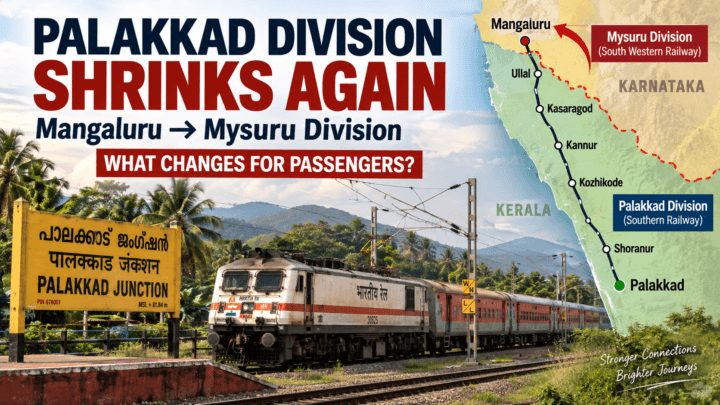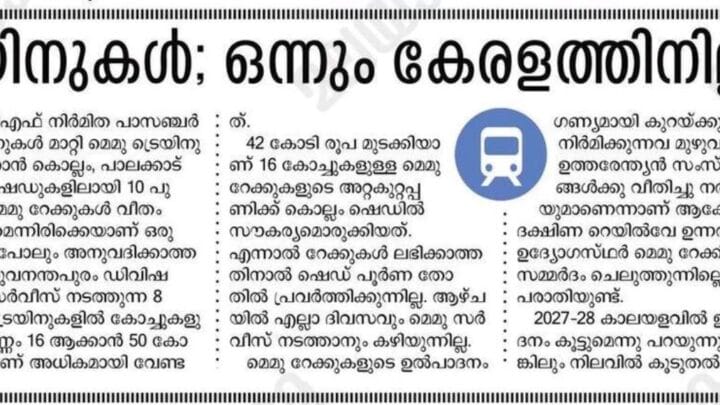
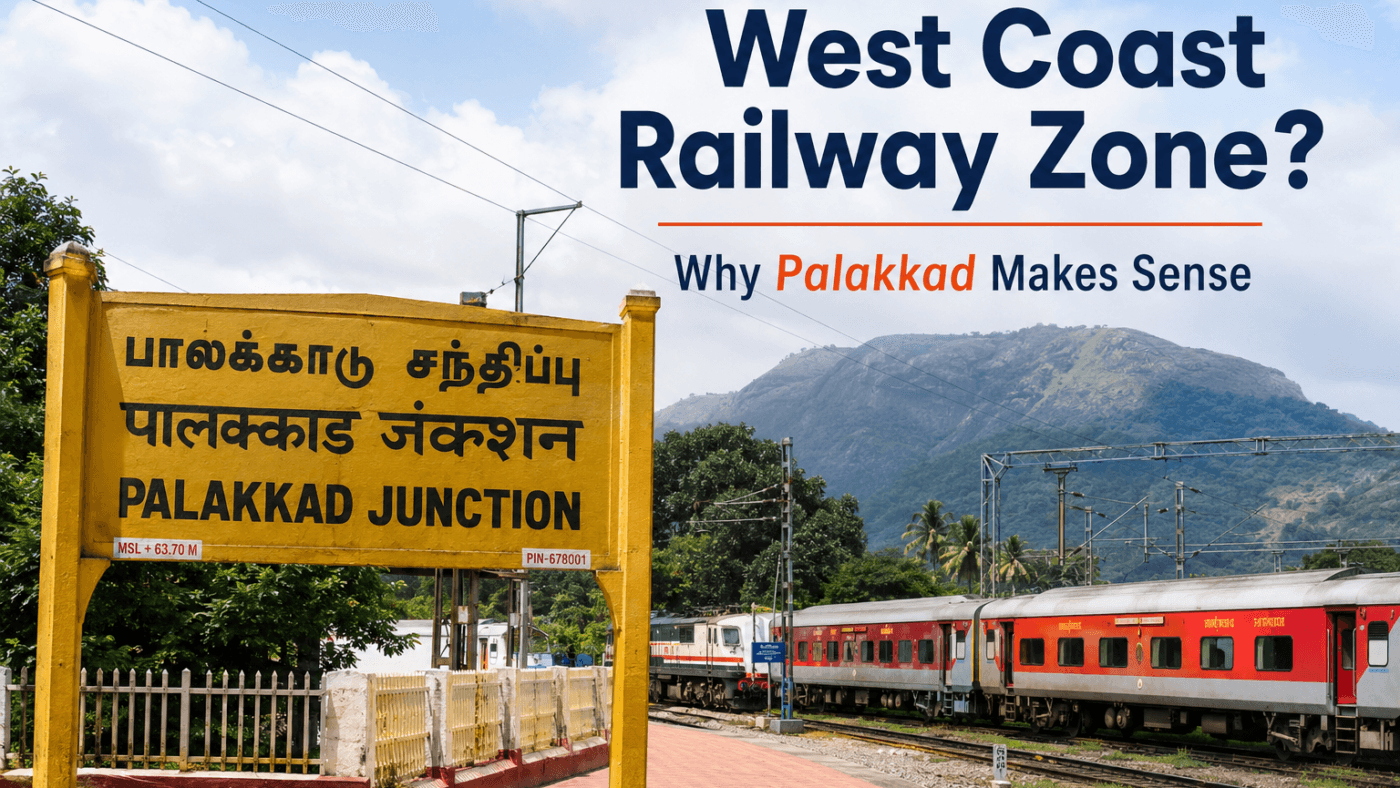
Instead, the state should consider demanding a new West Coast Railway Zone, with Palakkad as its headquarters.
This is an idea that deserves serious technical, political and public discussion.
Kerala’s Railway Problem Is Bigger Than One Divisional Boundary
Whenever there is a proposal to transfer railway territory from the Palakkad Division to another railway division, public discussion naturally focuses on what Palakkad might lose.
But the underlying issue is much larger.
Kerala is one of India’s most railway-dependent regions. The state’s settlement pattern is highly linear, with major towns and cities spread along a relatively narrow north-south corridor.
Railways therefore play an unusually important role in:
- inter-city passenger transport,
- long-distance travel,
- daily commuting,
- tourism,
- freight movement, and
- connecting Kerala with the rest of India.
Despite this, railway administration affecting Kerala remains divided between different divisions and administrative structures.
The question should therefore not be limited to:
How can Palakkad Railway Division retain its existing territory?
The more important question is:
What railway administrative structure will best serve Kerala and the west coast over the next several decades?
Why Palakkad Is a Strong Candidate for Railway Zone Headquarters
Palakkad has a strong historical, geographical and operational claim to become the headquarters of a future West Coast Railway Zone.
The Palakkad Railway Division was formed on 31 August 1956.
But railway history in the region goes much further back.
Railway development in this part of southern India began during the earliest expansion of railways into the Malabar region.
Historical records of Southern Railway state that the railway line between Podanur and Pattambi was developed during the early 1860s.
The Beypore-Tirur section opened on March 12, 1861, followed by other extensions. The Pattambi-Podanur section opened on April 14, 1862, and the remaining Kuttippuram-Pattambi section was completed later that year.
The railway was eventually extended northwards towards Mangalore.
Palakkad Division Was Once Much Larger
One of the most important facts in the present debate is that the Palakkad Railway Division has already undergone major territorial reductions.
Before the creation of the Thiruvananthapuram Railway Division, Palakkad Division reportedly controlled approximately:
1,247.58 route kilometres.
When the Thiruvananthapuram Railway Division was created on October 2, 1979, the Shoranur-Cochin Harbour Terminus section was transferred from Palakkad Division.
After this reorganisation, the route length controlled by Palakkad Division declined to approximately:
1,132.98 route kilometres.
Another major change came with the formation of the Salem Railway Division on November 1, 2007.
Following that restructuring, the present Palakkad Division was reduced to approximately:
577.74 route kilometres.
This means that Palakkad Division has already lost a substantial portion of the railway territory it historically administered.
Any proposal for further territorial reduction therefore deserves careful scrutiny.
Palakkad Is More Than Just Another Railway Town
Palakkad’s importance is not merely administrative.
Its geography makes it one of the most strategically important railway locations in southern India.
The Palakkad Gap provides one of the most important natural passages through the Western Ghats.
For centuries, this geographical opening has connected Kerala’s west coast with the Tamil Nadu plains.
Railways naturally followed the same geography.
Today, the Palakkad region links Kerala’s railway network with Tamil Nadu and the wider Indian railway system through several important corridors.
- Kerala’s main north-south railway corridor
- Palakkad-Coimbatore corridor
- Palakkad-Pollachi-Dindigul corridor
- Shoranur and northern Kerala routes
- Freight routes connecting Kerala with Tamil Nadu and the national network
This makes Palakkad an important railway gateway rather than simply an intermediate station.
The Historical Importance of the Palakkad-Pollachi Railway
The strategic importance of the Palakkad-Pollachi railway line is not a modern argument.
Historical records describing the original Pollachi-Palghat Railway explain that approximately 20 miles of the railway passed through the then Palghat taluk.
Stations mentioned in historical accounts included:
- Muthalamada,
- Kollengode,
- Pudunagaram, and
- Palghat.
The line was opened in 1932.
Contemporary records described it as providing a more direct railway connection between Palghat and Dindigul.
The route passed through populated and commercially important areas and was expected to support the development of regional trade.
Almost a century later, the underlying geographical advantage remains exactly the same.
What Could a West Coast Railway Zone Look Like?
The proposal discussed in the newspaper report envisages restructuring railway administration around Kerala and the adjoining west-coast railway network.
A future West Coast Railway Zone could potentially include railway divisions centred on Kerala, including Palakkad and Thiruvananthapuram, along with suitable adjoining railway territories.
The exact boundaries would require detailed study by the Railway Board and the Ministry of Railways.
Railway zones cannot be sensibly created merely by following state borders.
Several operational factors must be considered, including:
- train operating patterns,
- traffic density,
- crew management,
- locomotive and coach maintenance,
- terminal capacity,
- freight corridors,
- signalling systems,
- workshops,
- passenger demand, and
- future network expansion.
But the principle behind the proposal is valid:
Railway administrative boundaries should reflect modern passenger demand and operational reality, not simply administrative arrangements inherited from decades ago.
Kerala Generates Enormous Railway Passenger Demand
Kerala’s railway problem is certainly not a shortage of passengers.
In many cases, the exact opposite is true.
Popular trains passing through Kerala routinely experience very high demand.
Obtaining confirmed reservations on important routes can be difficult, particularly during weekends, holidays and festival periods.
Long waiting lists are common on several major routes.
This highlights an important point.
Railway administrative importance should not be measured only by the geographical size of a railway network.
A relatively short railway network carrying very high passenger volumes can require greater infrastructure investment and operational management than a much larger but lightly used network.
Important parameters should therefore include:
- passenger density,
- train occupancy,
- revenue generation,
- line utilisation,
- terminal congestion, and
- projected future demand.
The Salem Division Precedent Cannot Be Ignored
The creation of Salem Railway Division in 2007 provides an important historical precedent.
Large railway territories previously administered by Palakkad were transferred when the new division was formed.
After that restructuring, Palakkad Division’s route length was reduced to approximately 577.74 kilometres.
Now concerns relating to further changes on the Mangaluru side of Palakkad Division have brought the issue back into public discussion.
Looking at every territorial transfer as an isolated event misses the larger issue.
If railway sections continue to be detached from Palakkad whenever neighbouring administrative demands arise, an obvious question must be asked:
At what point does the continued reduction begin to weaken the operational relevance and strategic importance of Palakkad Railway Division itself?
Move From Defensive Politics to Long-Term Railway Planning
This is where the proposed West Coast Railway Zone offers a different way of looking at the issue.
Instead of repeatedly asking:
“How do we stop another section from being removed from Palakkad?”
Kerala should ask:
“What railway administrative system does Kerala need for the next 30 or 40 years?”
That is a much more useful policy question.
What Could a Kerala-Focused Railway Zone Achieve?
Creating a railway zone will not automatically solve Kerala’s railway problems.
A new headquarters building does not create railway capacity.
Nor does simply renaming administrative boundaries produce more trains.
However, railway administrative structures do matter.
A zone focused primarily on the railway requirements of Kerala and the adjoining west coast could potentially provide greater attention to several long-standing problems.
1. More Regional and Commuter Trains
Kerala badly needs better short and medium-distance passenger services.
Many passengers currently depend on long-distance express trains even for relatively short journeys.
A properly planned regional rail system could provide frequent services between important urban and semi-urban centres.
2. Better Terminal Development
Kerala needs significant investment in terminal capacity.
Important railway centres such as:
- Palakkad,
- Shoranur,
- Kozhikode,
- Kannur,
- Ernakulam, and
- Thiruvananthapuram
require long-term capacity planning rather than piecemeal improvements.
3. Third and Fourth Railway Lines
Several sections of Kerala’s railway network face increasing capacity pressure.
Adding trains indefinitely on heavily utilised double-line corridors is not practical.
Third and fourth railway lines will eventually become necessary on the busiest sections.
4. More Pit Lines and Stabling Facilities
One of the most overlooked problems in railway development debates is maintenance infrastructure.
Demanding new originating trains achieves little if stations lack:
- pit lines,
- stabling lines,
- coach maintenance facilities, and
- adequate terminal capacity.
Infrastructure must come before or alongside new train services.
5. Better Freight Planning
Kerala is a major consumer economy with important ports, fuel terminals, industries and logistics requirements.
Rail freight could play a much larger role in reducing road congestion and improving logistics efficiency.
A railway administration with stronger regional focus could potentially improve freight planning involving ports, container traffic and industrial centres.
The Palakkad-Pollachi Line Must Be Part of the Future Strategy
The Palakkad-Pollachi railway line deserves particular attention in any long-term railway strategy.
The route has undergone gauge conversion and electrification.
However, its passenger potential remains considerably underutilised.
Historically, the corridor was built precisely because it provided a more direct railway connection between Palghat and southern Tamil Nadu.
That strategic value remains relevant today.
The corridor has the potential to support:
- Palakkad-Pollachi commuter trains,
- better regional connections towards Coimbatore,
- longer-distance trains towards Dindigul, Madurai and southern Tamil Nadu,
- additional freight movement where operationally feasible, and
- improved connectivity for Kollengode, Pudunagaram, Muthalamada and nearby areas.
A railway zone headquartered at Palakkad would naturally have a strong interest in developing both Kerala’s north-south trunk route and this important east-west connection.
This Should Not Become Kerala vs Karnataka or Kerala vs Tamil Nadu
Railway administrative debates can quickly deteriorate into state-versus-state arguments.
That would be counterproductive.
Karnataka has every right to demand better railway administration for Karnataka.
Tamil Nadu has the same right.
Kerala should make its case based on measurable railway requirements.
The argument for a West Coast Railway Zone should therefore be based on:
- passenger traffic,
- operational efficiency,
- railway geography,
- terminal requirements,
- future capacity needs,
- freight movement, and
- economic importance.
The case should not be:
“Take railway territory from another state and give it to Kerala.”
The stronger argument is:
Design railway administrative boundaries according to operational efficiency and the transport needs of the region.
If Palakkad is the strongest location for a new zonal headquarters, the demand should be supported with evidence.
Kerala’s MPs and MLAs Need a Long-Term Railway Agenda
This issue ultimately requires political action.
Kerala’s elected representatives frequently intervene when:
- a train stop is removed,
- a timetable is changed,
- a new train is demanded, or
- a railway administrative boundary becomes controversial.
Such interventions are necessary.
But they are not enough.
Kerala needs a coordinated 20 to 30-year railway development strategy.
That strategy should consider:
- Creation of a Kerala-focused or West Coast Railway Zone, subject to technical feasibility.
- Palakkad as a serious candidate for zonal headquarters.
- Strengthening Palakkad and Thiruvananthapuram Railway Divisions.
- Development of additional railway terminals in northern and southern Kerala.
- Third and fourth railway lines on heavily utilised corridors.
- More regional and commuter trains.
- Better utilisation of the Palakkad-Pollachi corridor.
- Additional pit lines, stabling lines and maintenance facilities.
- Better integration of ports and industrial areas with railway freight networks.
- Railway planning based on future passenger demand rather than only today’s timetable.
Without a long-term strategy, Kerala will continue fighting railway battles one train, one station and one divisional boundary at a time.
From Defending Palakkad Division to Strengthening Palakkad
The present debate therefore needs to move beyond simply defending the existing Palakkad Railway Division.
Any attempt to further weaken the division deserves proper technical and public scrutiny.
But preserving today’s administrative boundary should not be the final objective.
Palakkad has been part of Kerala’s railway history since the earliest expansion of the railway network into the region.
It lies beside one of southern India’s most important geographical gateways through the Western Ghats.
It connects Kerala’s west-coast railway network with Tamil Nadu and the wider national railway system.
It already possesses the institutional legacy and infrastructure of a major railway divisional headquarters.
The more ambitious proposal therefore deserves serious examination:
Create a West Coast Railway Zone and Make Palakkad Its Headquarters
This should not be presented merely as an emotional regional demand.
Nor should it become another Kerala-versus-neighbouring-states argument.
The proposal should be built on:
- passenger demand,
- railway geography,
- operational logic,
- historical importance,
- freight requirements,
- infrastructure capacity, and
- Kerala’s future transportation needs.
Kerala should not spend the next several decades merely fighting to retain whatever railway administrative territory remains.
It is time to start discussing what railway administration Kerala actually needs for the future.
About Roads & Rails
Roads & Rails works to promote public awareness about railway development, road safety, public transport, civic infrastructure and responsible mobility.
Website: www.roadsandrails.org
Related posts:
 Why Keralam Needs Its Own Railway Zone: A Serious Case for Better Rail Development
 Palakkad Junction, Shoranur & Thrissur Railway Stations: Trains, History and Kerala Rail Guide
 30 New MEMU Rakes, None for Kerala? Why the Reported Allocation Raises Serious Questions
Palakkad-Pollachi Railway Line: Trains and Timings Passengers Actually Need
30 New MEMU Rakes, None for Kerala? Why the Reported Allocation Raises Serious Questions
Palakkad-Pollachi Railway Line: Trains and Timings Passengers Actually Need