From 1932 to 2026: More Than a Branch Line
The Madras District Gazetteers: Malabar, Volume I records that the Pollachi-Palghat metre-gauge railway opened to traffic in April 1932. About 20 miles of the line ran through Palghat taluk, with stations at Mudalamada, Kollengode, Pudunagaram and Palghat. The Gazetteer described it as a feeder railway linking the broad- and metre-gauge systems and expected it to support trade across a populous and commercially important region.
In short, rural mobility, regional trade and cross-border connectivity were not later additions to the idea. They were part of the line’s original purpose. More historical context is available in our history of the Palakkad-Pollachi railway line.
- 1 April 1932: The Pollachi-Palghat metre-gauge line opened to traffic.
- 10 December 2008: Metre-gauge operations stopped for conversion to broad gauge.
- 2015: Gauge conversion was completed and passenger operations resumed after safety clearance.
- 2016: The gauge-converted line was formally inaugurated.
- March 2026: A Palakkad-Pollachi MEMU service was introduced.
The Official Gauge-Conversion Cost Is ₹350 Crore, Not ₹600 Crore
The original Facebook post stated that approximately ₹600 crore had been spent on gauge conversion. A Press Information Bureau release dated 13 March 2026, however, lists the cost of the 56-km Pollachi-Palghat gauge-conversion project as ₹350 crore. Some reports published around the 2016 inauguration described it as a ₹400-crore project.
The same PIB document assigns ₹610 crore to the separate 121-km Dindigul-Palani-Pollachi gauge-conversion project. Confusing these two projects is the likely source of the ₹600-crore claim. Electrification and later works involved additional expenditure, but no clear consolidated official figure was found that supports attributing ₹600 crore to the Pollachi-Palghat conversion alone.
The Position in 2026: Trains Exist, but the Commuter Pattern Is Incomplete
The claim that the line now receives only one or two trains also needs updating. In 2026, several daily, weekly and limited-day services use the corridor. Important examples include:
- 16343/16344 Amritha Express
- 22651/22652 MGR Chennai Central-Palakkad Superfast Express
- 16731/16732 Palakkad-Tiruchendur Express
- 66623/66624 Palakkad-Pollachi MEMU Passenger
- 16621/16622 Mangaluru-Rameswaram Weekly Express
- 16707/16708 Mangaluru-Tirunelveli Express
Train count alone is a poor measure of public usefulness. Express trains do not stop at every smaller station. More importantly, a local train is useful only when its direction and timing match work, education, healthcare and market travel.
Who Benefits From the New MEMU?
Southern Railway announced the 66623/66624 Palakkad-Pollachi MEMU as a five-days-a-week service. The notified pattern included an early-morning departure from Pollachi and an evening departure from Palakkad. Timetables can change, so passengers should verify the current operating days and timings through NTES or station enquiry before travelling.
This pattern mainly benefits passengers travelling from Pollachi, Muthalamada, Kollengode and Pudunagaram towards Palakkad in the morning and returning in the evening. Several commenters asked for the reverse commuter flow:
A morning service from the Palakkad-Kollengode side towards Pollachi and Coimbatore, with a practical evening return.
The new MEMU is therefore a welcome improvement, but it addresses only part of the corridor’s commuter demand.
Seven Major Demands Emerging From 43 Public Comments
1. Morning Palakkad-Pollachi and Evening Pollachi-Palakkad Service
Sudheesh B V suggested Pollachi-bound slots around 7 am, 9 am and 11 am. Subashmps Mani proposed a Palakkad-Pollachi-Palani service after 8 am with an afternoon return. Ravindranath Ravi offered detailed time slots designed around connecting trains.
This is the clearest and most immediate demand in the discussion. It may be studied through timetable and rake planning without waiting for every proposed infrastructure project to be completed.
2. A Palakkad-Pollachi-Coimbatore Local or Circular Train
Sunny A Rajan, Venkitakrishnan Audithyapuram, Subeer Kamarudheen, Vijayakumar K Athman and Sivaraman Rejani supported a local or circular pattern connecting Pollachi, Kinathukadavu, Podanur and Coimbatore.
Such a service would be relevant for work, study, treatment, shopping and other regular travel. It would require coordination because Pollachi is under Palakkad Division, while Podanur and Coimbatore are under Salem Division. This is the valid operational concern in Padmanabhan Vaideeswaran’s comment. A divisional boundary, however, should be treated as a coordination issue, not as a permanent excuse for poor connectivity.
3. Connections to Palani, Dindigul, Madurai and Rameswaram
Rameswaram was the most frequently repeated long-distance destination. Suggestions from Sarin C Vennakkara, Murugan Muruganerat, Mohanam Mohandas, Mohamed Hanifa and Subhash Akkappalli extended to Madurai, Tirunelveli, Nagercoil, Kanyakumari, Tuticorin, Tambaram and Velankanni.
There may be genuine demand, particularly for pilgrimage travel and access to southern Tamil Nadu. But asking for many long-distance trains at once weakens the case. Passenger counts, reservation demand, occupancy on existing services and maintenance capacity should be used to identify a priority corridor. Based on the discussion, a Palakkad-Palani or Palakkad-Dindigul local/intercity connection appears to be a logical first priority, followed by an overnight Rameswaram connection if demand is demonstrated.
4. Extensions From Shoranur, Guruvayur or Alappuzha
Santhosh Ottapalam asked for a Shoranur-Palani MEMU. Mathews Kt proposed a daily service from the Alappuzha side through Pollachi and Palani. Neelakandan Nambeesan Chulliyil suggested a wider network linking origins such as Guruvayur, Kannur and Mangaluru with destinations in southern Tamil Nadu.
Extensions could benefit passengers from northern and central Kerala. They must, however, be tested against path availability on the busy Shoranur-Palakkad main line. In railway operations, the physical existence of a route does not automatically mean that a new train can be inserted immediately.
5. Smaller Stations and Vadakannikaapuram
The new MEMU provides stops at Pudunagaram, Kollengode and Muthalamada. It is therefore incorrect to say that these stations receive no train stops. The real demand is for more local stops at useful times.
Ananth Kondhath raised the case of Vadakannikaapuram, which is not currently an operational halt. Restoring it would require more than a timetable change. Station reopening, platform and signalling requirements, safety and commercial justification would need a separate proposal.
6. Palakkad Town Pit Line, Town-Parli Bypass and Doubling
Vishnu Mohan C, Lakshmi Narayanan and Ananth Kondhath argued that completing the Palakkad Town pit line could support more originating trains. This is a sound operational point. A Lok Sabha reply dated 26 March 2025 confirmed that a pit line had been sanctioned and the work taken up.
A pit line is particularly important for maintaining long-distance trains that originate or terminate at Palakkad Town. It is not necessarily a precondition for every short-distance MEMU. A local service may be possible earlier if its rake can be maintained at another approved facility.
The Press Information Bureau reported sanction for the 1.8-km Palakkad Town-Parli bypass at a cost of ₹163.57 crore. The bypass is intended to reduce reversal and detention for trains using this route. Reports in 2026 also referred to approval of a final location survey for doubling the Palakkad-Pollachi-Podanur corridor. A survey approval is not the same as construction sanction. A detailed project report, administrative approval, funding and execution must follow.
7. Political Follow-up Backed by Passenger Data
George Jaison asked the Palakkad MP to take the initiative. Srijith M called for action from Southern Railway and Union ministers. Vilayannur Krishnan made the pointed observation that elected representatives might press the demand more seriously if they regularly experienced the poor road conditions on the corridor.
Political follow-up matters. But a generic letter asking for “more trains” is weak. A credible proposal should include station-wise demand, preferred timings, current travel modes, ticket sales, bus occupancy and college and office shift patterns.
Fact-check: What Is Correct, Misleading or Unproven?
| Claim | Assessment |
|---|---|
| Gauge conversion cost ₹600 crore | Incorrect for this project. PIB lists the Pollachi-Palghat conversion at ₹350 crore. The separate Dindigul-Palani-Pollachi project is listed at ₹610 crore. |
| Only one or two trains use the route | Outdated generalisation. Several daily, weekly and limited-day services use the line in 2026. Local-friendly frequency and timing remain inadequate. |
| The new MEMU began in March 2026 | Correct. The inaugural run was on 11 March, followed by regular service. |
| About seven services operated during the metre-gauge period | Plausible archival claim, but it needs a timetable scan. A commenter supplied old train numbers. The relevant Southern Railway timetable would be needed for conclusive verification. |
| Broad gauge destroyed the route | The delayed restoration of services is a fair criticism; the causal claim is not proven. Gauge width itself does not determine service levels. Timetabling, rake availability, terminal capacity and policy priorities do. |
| A “Tamil lobby” is blocking the route | Unsupported allegation. Divisional boundaries, pathing and terminal capacity are real operational issues. No evidence for an ethnic or regional conspiracy was offered. |
| More local trains are impossible until doubling | Only partly true. Doubling would increase capacity. A timetable study may still find paths for some additional services on the present single line. |
| No new train can start before the pit line is completed | Not fully correct. A pit line is important for long-distance originating trains. A short local or MEMU service may use a different approved maintenance arrangement. |
A Practical Service Package Based on the Discussion
If the 43 comments are reduced to a realistic railway proposal, the priorities could be:
- Reverse-direction commuter MEMU: Depart Palakkad at approximately 6:30-7:00 am and Pollachi at approximately 6:00-7:00 pm. Final timings must follow a passenger survey and operational path study.
- Midday connector: A Palakkad departure between approximately 10:30 and 11:30 am towards Palani or Dindigul, with an afternoon return and useful connections from the Shoranur, Ernakulam and Mangaluru directions.
- Coimbatore through service: Study the feasibility of extending at least one MEMU pair to Coimbatore through Pollachi, Kinathukadavu and Podanur.
- Station coverage: Retain local stops at Palakkad Town, Pudunagaram, Kollengode, Muthalamada, Minatchipuram and Anaimalai Road. Examine reopening Vadakannikaapuram as a separate project.
- Long-distance priority: First study a Palakkad-Palani or Palakkad-Dindigul intercity service. Consider an overnight Rameswaram service in a later phase if passenger data supports it.
- Infrastructure: Commission the pit line, implement the Town-Parli bypass and pursue the doubling proposal beyond the survey stage.
The Passenger Data Railway Planners Actually Need
Facebook responses are a useful starting point, but they are not a scientific ridership survey. A formal representation should collect:
- Starting station and destination
- Preferred morning departure
- Preferred evening return
- Daily or weekly travel frequency
- Current travel mode: bus, two-wheeler, car or train
- Present one-way cost and journey time
- Purpose: work, education, healthcare, trade, pilgrimage or tourism
Station-wise ticket sales, occupancy of existing trains, line capacity, crossing constraints and rake availability should also be sought through official records or RTI. Emotion attracts attention. Evidence gives decision-makers less room to ignore the demand.
The Full Discussion: Comment-by-Comment Index
The following is a concise index of the 43 comments in the supplied spreadsheet. A name links to the commenter’s public profile where available; “View comment” links to the Facebook source recorded in the export. Personal details such as phone numbers have been deliberately excluded.
Open the index of all 43 comments
- Subhash Akkappalli: Palakkad-Pollachi-Madurai-Tirunelveli-Nagercoil-Kanyakumari service. View comment
- Sarin C Vennakkara: Palakkad-Tambaram via Pollachi-Dindigul. View comment
- Sarin C Vennakkara: Palakkad Town-Rameswaram daily overnight express. View comment
- Sarin C Vennakkara: Palakkad-Rameswaram daily intercity. View comment
- Sarin C Vennakkara: Palakkad-Thiruvananthapuram intercity via Pollachi-Palani-Dindigul-Madurai-Nagercoil. View comment
- Sarin C Vennakkara: Palakkad-Kollam via Pollachi-Dindigul-Madurai-Sengottai. View comment
- Sarin C Vennakkara: Palakkad-Tuticorin via Pollachi-Palani-Dindigul-Madurai. View comment
- Sarin C Vennakkara: Palakkad-Velankanni Express. View comment
- Sarin C Vennakkara: Palakkad-Dindigul MEMU. View comment
- Sarin C Vennakkara: Palakkad-Coimbatore MEMU via Pollachi-Kinathukadavu. View comment
- Vishnu Mohan C: Palakkad Town pit line completion may enable more services. View comment
- Sunny A Rajan: Olavakkode-Palakkad-Pollachi-Kinathukadavu-Coimbatore circular shuttle. View comment
- Murugan Muruganerat: Two pairs to Madurai and two to Rameswaram. View comment
- Murugan Muruganerat: Palakkad-Tirupati via Pollachi-Dindigul-Salem. View comment
- Murugan Muruganerat: Shoranur-Palani MEMU. View comment
- Sudheesh B V: Morning Pollachi-bound trains around 7, 9 and 11. View comment
- Bv Sivasankar: Restore metre-gauge-era links and add local and long-distance trains. View comment
- Santhosh Ottapalam: Shoranur-Palani MEMU. View comment
- Venkitakrishnan Audithyapuram: Palakkad-Pollachi-Coimbatore circular MEMU to reduce road congestion. View comment
- Ahmed Kutty: Multiple Pollachi-Palakkad and Palakkad-Palani time slots. View comment
- Neelakandan Nambeesan Chulliyil: A wider Kerala-southern Tamil Nadu service network and circular MEMU. View comment
- Sudheesh Ponnarath: Historical train list and 2026 MEMU/current-service summary. View comment
- Vilayannur Krishnan: Representatives should experience the poor Palakkad-Pollachi road and press for trains. View comment
- Prasana Kumar: Extend the Coimbatore-Bengaluru UDAY Express to Palakkad and seek a Mayiladuthurai service. View comment
- Ananth Kondhath: Vadakannikaapuram closure and the Palakkad Town pit line. View comment
- Palakkad Roads & Rails: Asked users for origin, destination, preferred time, frequency and present travel mode. View comment
- Srijith M: Called for action from Southern Railway and Union ministers. View comment
- Prajith Kumar: Criticised the post-conversion decline in services and alleged regional lobbying. View comment
- Mohamed Hanifa: Rameswaram pilgrimage link and possible use of the Chennai-Palakkad rake. View comment
- Sanju S Sanju: Pointed out a long daytime gap and suggested Madurai-bound services around 10:00 and 12:30. View comment
- Subeer Kamarudheen: Morning and evening Pollachi-Coimbatore link with Vadakannikaapuram and Pudunagaram stops. View comment
- Vijayakumar K Athman: Ring service connecting Palakkad, Kollengode, Pollachi and Coimbatore. View comment
- Syed Mohammed Thangal: Supported the demand as reasonable. View comment
- Ravindranath Ravi: Detailed slots for Palani, Pollachi and Rameswaram services and connecting trains. View comment
- Iqbal Kuniya: Alleged that the Coimbatore-Pollachi line led to neglect of Palakkad-Pollachi. View comment
- Mohanam Mohandas: Daily Palakkad-Rameswaram Express around 22:00. View comment
- Mathews Kt: Daily service from the Alappuzha side via Pollachi and Palani. View comment
- Subashmps Mani: Morning Palakkad-Pollachi-Palani and afternoon return. View comment
- Lakshmi Narayanan: Doubling, Palakkad-Madurai MEMU, pit line and Town-Parli bypass. View comment
- Padmanabhan Vaideeswaran: Flagged Palakkad-Salem divisional jurisdiction issues. View comment
- George Jaison: Asked the Palakkad MP to take the initiative with the Railway Ministry and Railway Board. View comment
- Srajudeen Athaloor: Proposed Palakkad-Palani MEMU slots and connections with train 16607. View comment
- Sivaraman Rejani: Frequent short rural trains, circular connectivity, tourism and local economic benefits. View comment
Conclusion: Usefulness Matters More Than Train Count
Calling the Palakkad-Pollachi line completely “unused” would be an exaggeration in 2026. More services, including the new MEMU, now operate over the route. That does not invalidate the central criticism.
The corridor still needs a dependable morning local service from the Palakkad side towards Pollachi and Coimbatore, with an evening return. The long daytime gap and village-station connectivity also need attention. The long-distance wish list must be converted into a few priority projects supported by passenger data.
The real public return on the ₹350-crore gauge conversion cannot be measured merely by new track. The investment succeeds when residents of Pudunagaram, Kollengode, Muthalamada, Palakkad and Pollachi can reach education, work, healthcare and markets without depending on a private vehicle.
Make the demand specific: state your starting station, destination, preferred morning departure, return time, travel frequency and current mode of transport. A comment expresses a need. Data turns it into a case the Railway cannot dismiss casually.
Frequently Asked Questions
Is there a Palakkad-Pollachi MEMU now?
Yes. The 66623/66624 MEMU was introduced in March 2026 as a five-days-a-week service. Check the current operating days and timings through NTES or station enquiry before travelling.
Does the MEMU stop at Kollengode, Muthalamada and Pudunagaram?
The announced schedule included stops at Palakkad Town, Pudunagaram, Kollengode, Muthalamada, Minatchipuram and Anaimalai Road.
How much did the Palakkad-Pollachi gauge conversion cost?
A March 2026 PIB release lists the Pollachi-Palghat gauge-conversion project at ₹350 crore. Some reports published around the inauguration described it as a ₹400-crore project.
Is a Palakkad-Coimbatore local train via Pollachi possible?
The railway route exists. Operational feasibility would depend on path availability, rake availability, timings and coordination between Palakkad and Salem divisions. It is a proposal worth formally studying, not a service that can be promised without operational analysis.
Has doubling of the line been sanctioned?
Reports in 2026 referred to approval of a final location survey for doubling the Palakkad-Pollachi-Podanur corridor. Survey approval is not construction sanction.
Sources and methodology: Madras District Gazetteers: Malabar, Volume I; Ministry of Railways and Press Information Bureau releases; Southern Railway notices; Lok Sabha reply dated 26 March 2025; Railway Board coaching circular; and the Facebook discussion exported on 10 August 2026. Public comments are analysed as proposals, not treated as official facts. Railway timetables can change; verify live timings through NTES or station enquiry.
Related posts:
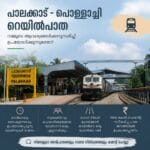 Palakkad-Pollachi Railway Line: A ₹350-Crore Upgrade, a 94-Year History – But Are We Using It Properly?
 Palakkad Junction, Shoranur & Thrissur Railway Stations: Trains, History and Kerala Rail Guide
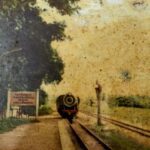 The Palakkad-Pollachi Railway Line: A Forgotten Lifeline?
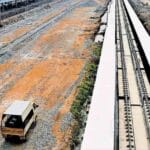 Pit Line Construction Progressing at Palakkad Town Railway Station