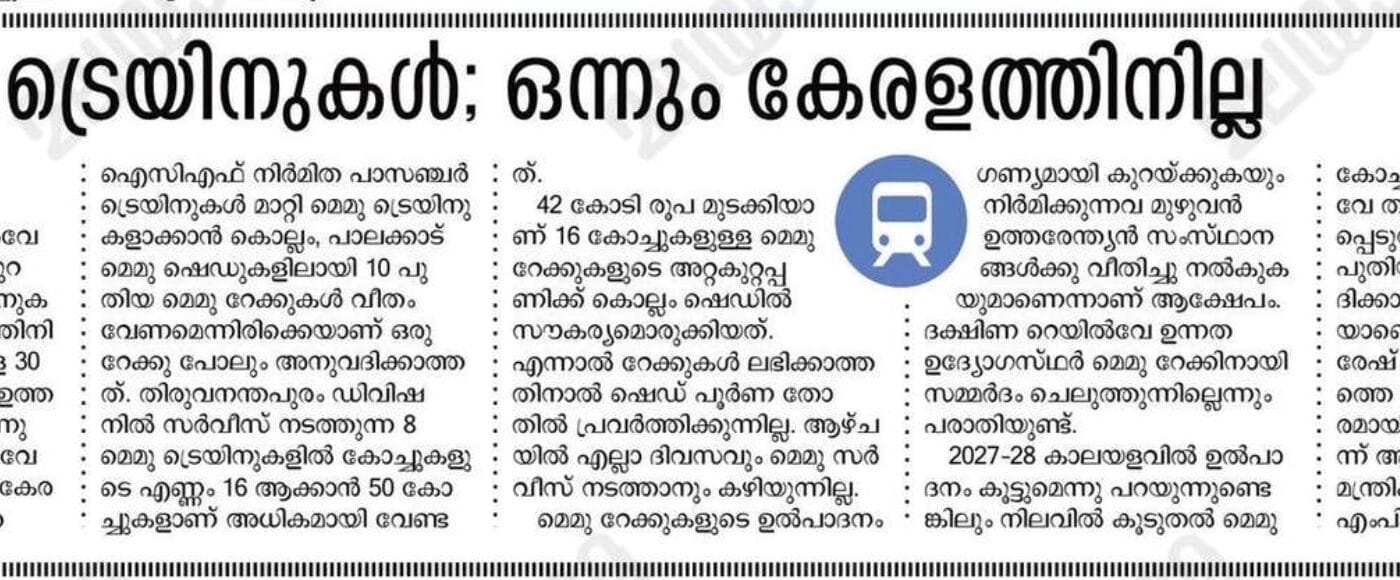
Important verification note: At the time of writing, we have not found a Railway Board or Indian Railways document independently confirming the newspaper’s specific claim that all 30 new MEMU rakes have already been allocated and Kerala has been excluded.
Therefore, the figure should presently be treated as a reported allocation rather than an independently verified Railway Board decision.
But the larger concern raised by the report is supported by available evidence: Kerala needs significantly greater MEMU capacity and better regional railway services.
What Exactly Is a MEMU?
MEMU stands for Mainline Electric Multiple Unit.
Unlike a conventional passenger train in which a locomotive pulls a rake of coaches, a MEMU uses distributed electric traction equipment within the train formation.
This allows MEMUs to accelerate and decelerate relatively quickly, making them particularly suitable for routes with frequent stops.
For densely populated regions such as Kerala, this type of service can be extremely useful.
A properly planned MEMU network can serve:
- Daily office commuters
- Students
- Short-distance passengers
- Workers travelling between neighbouring towns
- Passengers connecting with long-distance trains
- Patients travelling to hospitals and medical centres
- Small traders and local businesses
- People who would otherwise depend on buses, cars and motorcycles
MEMUs therefore should not be viewed as secondary or insignificant trains.
For a state with Kerala’s population density and settlement pattern, regional electric trains should form one of the foundations of public transport.
Kerala’s MEMU Demand Is Already Visible
The argument for additional MEMU capacity is not theoretical.
Railway authorities themselves have been increasing the capacity of existing Kerala MEMU services.
In February 2026, the carrying capacity of several MEMU services in Kerala was increased, including trains operating on the Palakkad-Ernakulam, Kollam-Ernakulam and Kollam-Kottayam sectors.
These decisions clearly indicate that passenger demand already exists.
If existing trains require more coaches because they are overcrowded, the logical response cannot indefinitely be to keep extending the same limited number of services.
At some point, Kerala also needs additional rakes and additional train frequencies.
Source:
ThePrint – Three MEMU trains in Kerala to add coaches
Overcrowding Remains a Serious Problem
Recent reports continue to show overcrowding and capacity concerns on Kerala’s commuter trains.
In July 2026, concerns were raised after MEMU capacity was reportedly reduced during peak-hour operations in the Kochi region.
Office workers, students and other regular passengers were among those affected.
This highlights an important distinction.
The relevant question is not simply whether Kerala technically has MEMU trains.
The real questions are:
- Are there enough services?
- Are trains operating at useful times?
- Do they have adequate capacity?
- Are there enough rakes to introduce additional services?
- Are peak-hour passenger loads being properly addressed?
Running an overcrowded MEMU does not prove that commuter demand has been adequately served. In many cases, it proves exactly the opposite.
Source:
Times of India – Concerns over MEMU coach reduction during rush hour
Increasing Coaches Helps – But It Is Not Enough
Southern Railway has responded to increasing demand partly by increasing the number of coaches in existing MEMU formations.
This is useful.
A 12-car train obviously provides substantially greater capacity than an eight-car rake.
But coach augmentation has practical limits.
Consider a corridor where most commuters need to travel between:
- 7 AM and 10 AM
- 4 PM and 8 PM
Adding four coaches to one train helps.
But commuters may benefit far more from having two properly spaced services instead of one extremely long train operating at an inconvenient time.
Railway capacity is not only about the number of coaches. Frequency matters just as much.
A train that arrives three hours after commuters need it is practically useless to them, irrespective of whether it has eight, twelve or sixteen coaches.
Kerala Needs a Regional Railway Strategy
Kerala is exceptionally suitable for frequent regional rail.
The state’s population is distributed through a long chain of closely spaced towns and cities rather than being concentrated in only one or two giant metropolitan areas.
Consider corridors such as:
- Palakkad – Ottapalam – Shoranur – Thrissur – Ernakulam
- Kozhikode – Tirur – Shoranur
- Ernakulam – Kottayam – Kollam
- Ernakulam – Alappuzha – Kollam
- Thiruvananthapuram – Kollam
- Palakkad – Pudunagaram – Kollengode – Muthalamada – Pollachi
These are not simply long-distance railway corridors.
They connect employment centres, educational institutions, hospitals, commercial centres, government offices and residential communities.
Frequent MEMU services could therefore perform a role somewhere between traditional passenger trains and modern suburban rail.
The Palakkad-Pollachi Line Shows the Problem Clearly
The Palakkad-Pollachi railway corridor deserves special attention in this discussion.
The route connects locations including:
- Palakkad
- Pudunagaram
- Kollengode
- Muthalamada
- Pollachi
The Palakkad-Pollachi railway is not a new transport corridor.
Historical records describing the Pollachi-Palghat Railway noted that the line passed through populated and economically important areas and was expected to improve trade and communication between Palghat and regions towards Dindigul and southern Tamil Nadu.
The historical Palghat Division itself has deep railway roots. The railway network in the region developed during the nineteenth century, with the Pattambi-Podanur section opening in 1862. Palakkad later became an important Southern Railway division.
Today, however, infrastructure alone is not enough.
The Palakkad-Pollachi line has undergone major modernisation, including:
- Broad-gauge conversion
- Track renewal and related upgrades
- Electrification
- Signalling and operational improvements
Yet passenger utilisation remains limited compared with the potential of the corridor.
This creates one of the central contradictions of railway planning:
We spend large amounts upgrading railway infrastructure and then fail to operate enough ordinary passenger trains to make full use of it.
A railway line should not be evaluated merely by whether tracks, signalling and electrification exist.
Its real value should be measured by how effectively people can use it.
Palakkad-Pollachi Needs Regular Commuter MEMUs
The corridor could potentially support a much stronger pattern of regional passenger services.
Morning Direction
Pollachi – Muthalamada – Kollengode – Pudunagaram – Palakkad
This could benefit passengers travelling towards Palakkad for:
- Employment
- Education
- Healthcare
- Government services
- Business
- Connections with long-distance trains
Evening Direction
Palakkad – Pudunagaram – Kollengode – Muthalamada – Pollachi
This could provide a practical return journey after working hours.
Additional connectivity towards Coimbatore could make the corridor even more valuable.
The exact timetable must naturally be decided after operational and traffic studies by Southern Railway.
But the underlying principle is very simple:
Run trains when people actually need to travel.
Kerala Has MEMU Maintenance Infrastructure Too
Another important concern raised in the newspaper report relates to the Kollam MEMU shed.
The report says substantial investment has been made to improve facilities capable of handling longer MEMU formations, but inadequate availability of rakes is limiting utilisation.
Independent reporting has previously confirmed a project worth approximately ₹42 crore for development of the Kollam MEMU facility.
More recent reporting also indicated that development of the MEMU shed could significantly increase its maintenance capacity.
If maintenance capacity is being expanded while adequate rolling stock is not being provided, expensive infrastructure risks remaining underutilised.
That is poor asset utilisation.
Sources:
- Onmanorama – Kollam MEMU development and additional coaches
- Times of India – MEMU shed development at Kollam
Kerala Is Receiving Railway Investment – But Passengers Also Need Trains
This discussion should not be reduced to the simplistic argument that Kerala receives nothing from Indian Railways.
That would be incorrect.
The Union government’s official figures indicate substantial railway investment in Kerala.
For 2026-27, Kerala received a railway allocation of approximately ₹3,795 crore, while the value of ongoing railway projects in the state was stated to be approximately ₹18,041 crore.
This includes investment in areas such as:
- Station redevelopment
- Track improvements
- Bridges
- Capacity enhancement
- Safety works
- Passenger amenities
- Other railway infrastructure
Such investment is welcome.
But infrastructure investment and passenger-service adequacy are not the same thing.
A rebuilt station cannot substitute for a missing train.
A renovated platform cannot reduce overcrowding by itself.
Electrification does not automatically provide mobility.
Ultimately, railway infrastructure exists to move people and goods.
Official source:
Press Information Bureau – Railway investment in Kerala
Kerala’s Railway Debate Is Too Focused on Prestige Trains
Public discussion about Indian Railways increasingly revolves around premium services.
Vande Bharat trains attract enormous political and media attention.
New long-distance express services generate headlines.
Station redevelopment projects produce visible infrastructure and inauguration ceremonies.
These projects may have value.
But the less glamorous part of the railway system is arguably far more important to the everyday lives of ordinary people.
Daily commuter trains.
For thousands of passengers, the most important railway question is not whether a train can theoretically run at 160 km/h.
It is:
Can I reach my workplace by 9 AM and return home in the evening without travelling in an dangerously overcrowded train?
That is the real public-transport test.
One Additional MEMU Can Influence Thousands of Daily Journeys
The benefits of regional trains extend far beyond the passengers sitting inside them.
Every person who shifts from a private vehicle to rail can potentially mean:
- Fewer vehicles on congested roads
- Lower fuel consumption
- Reduced emissions
- Lower accident exposure
- Reduced parking demand
- Cheaper mobility
- Less stressful commuting
This is particularly relevant to Kerala.
Road widening in the state is expensive, difficult and socially disruptive because of dense roadside development.
Continuously increasing road capacity is neither financially nor physically sustainable.
Existing railway corridors therefore represent an enormous public asset.
Kerala Needs More Trains – Not Simply Longer Trains
The strategy of increasing existing MEMUs from eight to twelve coaches, and in some cases towards longer formations, is welcome.
But Kerala should not remain trapped in a system where every increase in demand is answered simply by attaching additional coaches.
At some point, frequency must increase.
A successful commuter railway system requires four basic components:
- Capacity
- Frequency
- Reliability
- Useful timings
Remove any one of these and the system becomes substantially less useful.
For example, a 16-coach train operating once every four hours is not automatically better than a 12-coach train operating every hour.
For many passengers, frequency matters more than train length.
The Reported 30-Rake Allocation Deserves Scrutiny
This brings us back to the newspaper report.
If Indian Railways is indeed distributing 30 new 12-car MEMU rakes and Kerala receives none, Railway Board should publicly explain the allocation criteria.
There are several straightforward questions that deserve answers.
- How many new MEMU rakes are currently being manufactured or allocated?
- Which railway zones and divisions are receiving them?
- What criteria determine rake allocation?
- What is Kerala’s current MEMU rake availability?
- What are the passenger loads on major Kerala MEMU corridors?
- How many additional MEMU rakes have Palakkad and Thiruvananthapuram divisions requested?
- How many additional rakes are required for proposed new services?
- What is the utilisation plan for expanded MEMU maintenance infrastructure at Kollam?
- Are additional MEMU services being considered for underutilised electrified corridors such as Palakkad-Pollachi?
These are measurable questions.
They deserve measurable answers.
Allocation Should Be Based on Demand – Not Political Geography
Kerala should not demand MEMU trains merely because another state received them.
That would be a weak transport argument.
The case should instead be made through objective indicators such as:
- Passenger demand
- Overcrowding
- Population served
- Existing train frequency
- Platform capacity
- Maintenance facilities
- Rake utilisation
- Road congestion
- Potential shift from private vehicles to rail
- Economic activity
- Daily commuter travel patterns
If these indicators justify additional trains, Kerala should receive them.
If another region demonstrates greater operational need, that too should be considered.
Public transport planning should be based on evidence, not political bargaining.
Railway Board Should Publish Rake Allocation Data
There is also a transparency problem.
Rolling-stock allocation is difficult for ordinary passengers to understand because consolidated information is rarely made publicly accessible.
Railway Board could improve transparency by publishing information such as:
- Total number of MEMU rakes available
- Rake age
- Home sheds
- Spare ratios
- Utilisation rates
- Planned manufacturing
- Zone-wise allocation
- Division-wise allocation
- Replacement requirements
Such information would allow debates about alleged discrimination or favouritism to be based on evidence rather than speculation.
Kerala MPs Should Raise the Issue Collectively
If the newspaper’s claim regarding the 30 new MEMUs is correct, Kerala’s Members of Parliament should seek formal clarification from the Ministry of Railways.
This should not become another predictable political argument between parties.
Railway capacity is a long-term infrastructure issue.
Governments change.
MPs change.
Ministers change.
Commuters remain.
Kerala’s representatives should collectively seek:
- Additional MEMU rakes
- Additional commuter services
- Better peak-hour schedules
- Greater utilisation of electrified routes
- Transparent rolling-stock allocation
- Better regional rail planning
Special Trains Cannot Replace Permanent Commuter Capacity
Kerala frequently receives special trains during festival periods.
These services are useful for temporary increases in demand.
But special trains do not solve the everyday transport requirements of people travelling:
- Monday morning
- Tuesday evening
- Wednesday morning
- Thursday evening
- Every working day of the year
Temporary demand can be met by temporary services.
Permanent demand requires permanent capacity.
What Kerala Should Demand
Kerala’s railway demands should move beyond vague slogans such as “we need more trains.”
A serious regional railway proposal should include the following.
1. Additional MEMU Rakes
Without rolling stock, additional services cannot operate.
2. Peak-Hour Commuter Services
Schedules should correspond with employment, education and business travel patterns.
3. Higher Frequency
High-demand corridors require more services rather than endlessly increasing train length.
4. Better Use of Branch Lines
Underutilised routes such as the Palakkad-Pollachi line should receive useful regional passenger services.
5. Integrated Regional Planning
MEMU timings should connect effectively with long-distance trains, buses and major employment centres.
6. Adequate Maintenance Capacity
Kollam and other MEMU facilities should be used efficiently.
7. Transparent Allocation Criteria
Railway Board should clearly explain how new rakes are distributed among zones and divisions.
8. Passenger-Demand Studies
Decisions should be based on actual boarding figures, origin-destination patterns and peak-hour travel demand.
A Bigger Question – What Kind of Railway Does Kerala Need?
Kerala’s railway discussion needs to evolve.
The state does not merely need occasional new long-distance trains.
It needs something closer to a modern regional railway network.
Imagine reliable trains operating at useful intervals along corridors such as:
- Palakkad – Thrissur – Ernakulam
- Kozhikode – Tirur – Shoranur
- Ernakulam – Kottayam – Kollam
- Ernakulam – Alappuzha – Kollam
- Kollam – Thiruvananthapuram
- Palakkad – Kollengode – Pollachi
Such a system could fundamentally change mobility in Kerala.
It could also reduce dependence on increasingly congested highways.
The Railway Line Already Exists – Use It
Building entirely new transport infrastructure is extraordinarily expensive.
Indian Railways already possesses corridors connecting many of Kerala’s major towns.
That gives the state an enormous advantage.
The logical strategy should therefore be:
Upgrade tracks where necessary, improve line capacity, provide adequate rolling stock and operate frequent trains.
In several places, much of the expensive physical infrastructure already exists.
The missing element is often simply adequate passenger service frequency.
Conclusion
The reported decision to distribute 30 new 12-car MEMU rakes without providing any to Kerala has not yet been independently confirmed through an official Railway Board document.
That distinction is important and should not be ignored.
But the larger issue is real.
Kerala’s existing MEMU trains experience substantial passenger demand.
Southern Railway has already increased the capacity of several services.
Passengers continue to report overcrowding.
MEMU maintenance infrastructure is being expanded.
Major electrified railway corridors remain capable of carrying additional regional passenger services.
And Kerala’s geography makes frequent regional rail particularly suitable.
So the question should not merely be:
“Why didn’t Kerala get one of the 30 MEMUs?”
The larger question should be:
“How many MEMU rakes and services does Kerala actually require to build a functional regional commuter railway system?”
Railway Board, Southern Railway, Kerala’s MPs, passenger associations and local governments should work towards answering that question with data.
Because railway development should not be measured only in crores spent, stations renovated, projects announced or trains inaugurated.
It should ultimately be measured by something much simpler:
Can ordinary people get where they need to go, safely, affordably and at the time they need to travel?
If the answer is no, the railway system still has work to do.
Frequently Asked Questions
What is a MEMU train?
MEMU stands for Mainline Electric Multiple Unit. These electric trains are designed for relatively short and medium-distance routes with frequent stops and are particularly useful for commuter and regional passenger services.
Is it confirmed that Kerala will receive none of the 30 new MEMU rakes?
No official Railway Board allocation document confirming this specific claim has been independently located at the time of writing. The figure comes from the newspaper report and should therefore be treated as a reported allocation unless officially confirmed.
Why does Kerala need more MEMU trains?
Kerala has high population density, closely spaced towns, significant daily commuting demand and congested roads. Frequent MEMU services could provide affordable regional transport while reducing pressure on highways.
Why are longer MEMU trains not enough?
Increasing the number of coaches improves carrying capacity, but commuters also need frequent services at useful times. A longer train running infrequently cannot fully replace multiple well-timed services.
Could the Palakkad-Pollachi line support more passenger trains?
The line has undergone broad-gauge conversion and electrification and connects several important towns. Additional passenger services could potentially improve connectivity, but exact frequencies and timings require operational assessment by Southern Railway.
What should Kerala demand from Indian Railways?
Kerala should seek additional MEMU rakes, increased peak-hour frequency, better use of underutilised routes, transparent rake-allocation criteria, improved maintenance capacity and evidence-based regional railway planning.
Sources and Further Reading
Related posts:
 Palakkad-Pollachi Railway Line: Trains and Timings Passengers Actually Need
 Palakkad-Pollachi Railway Line: A ₹350-Crore Upgrade, a 94-Year History – But Are We Using It Properly?
 Why Keralam Needs Its Own Railway Zone: A Serious Case for Better Rail Development
Palakkad Junction, Shoranur & Thrissur Railway Stations: Trains, History and Kerala Rail Guide
Why Keralam Needs Its Own Railway Zone: A Serious Case for Better Rail Development
Palakkad Junction, Shoranur & Thrissur Railway Stations: Trains, History and Kerala Rail Guide